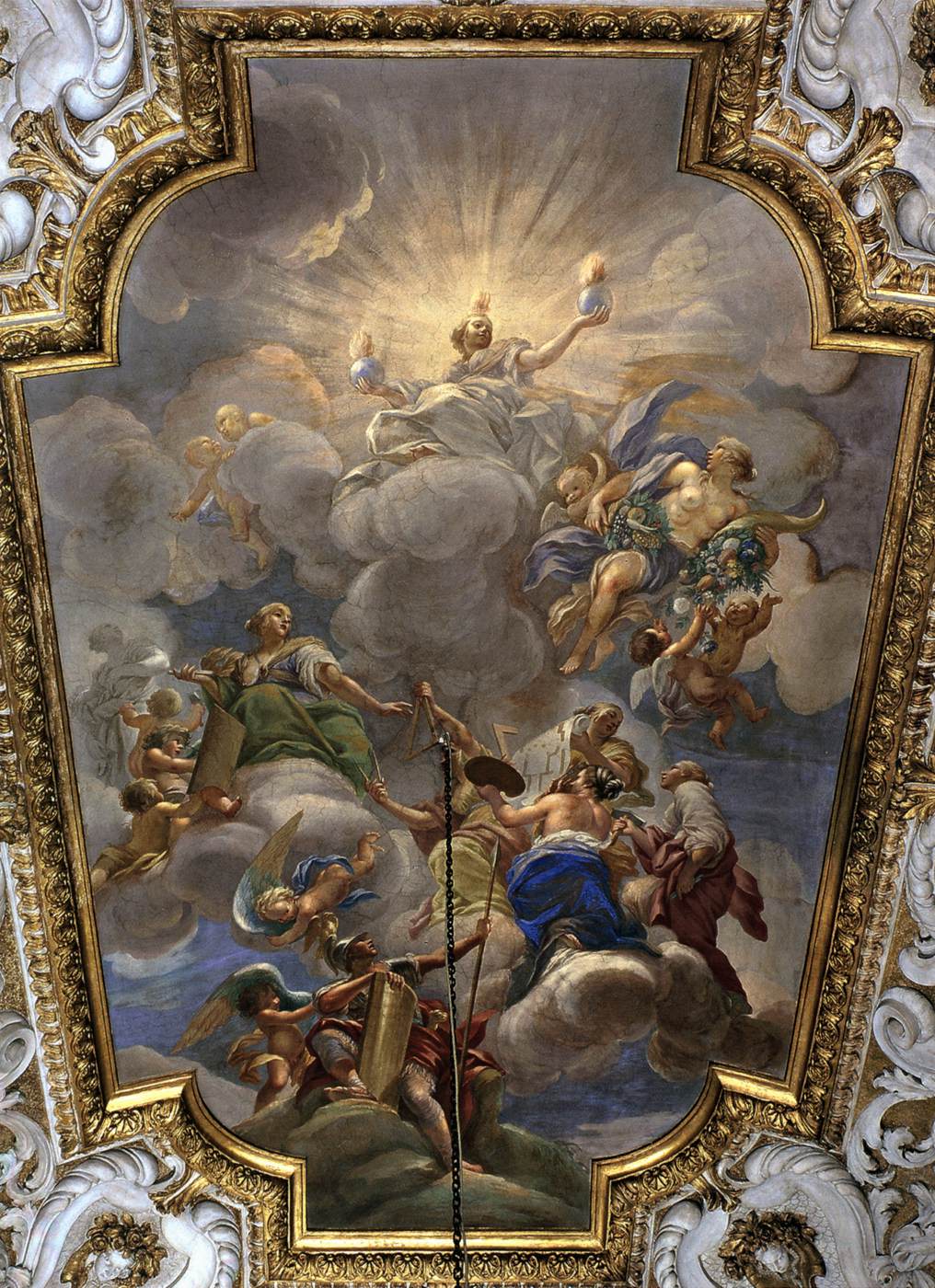
Anton Domenico Gabbiani
1652 – 1726
Italian painter. He first trained with the Medici court portrait painter Justus Sustermans and then with the painter Vincenzo Dandini. On 20 May 1673 he arrived in Rome, where he studied for three years under Ciro Ferri and Ercole Ferrata at the Accademia Fiorentina. He responded in particular to the paintings of Pietro da Cortona and Carlo Maratti who were both to be important influences on him. Though not precocious, Gabbiani became one of the most noted painters from the Accademia. After a period in Venice (1678-79) with the portrait painter Sebastiano Bombelli, he was in Florence in 1680. By 1684, the year in which he executed an Annunciation (destroyed) for the Palazzo Pitti, he was an independent painter. His first important public commission, the St Francis de Sales in Glory (1685) for the church of Santi Apostoli, Florence (in situ), shows the influence of Maratti in its grandiose composition and that of Dandini in the treatment of figures. In Prince Ferdinando de' Medici Gabbiani found a particularly loyal patron, and he painted his portrait, Ferdinando de' Medici and his Musicians (c. 1685, Florence, Pitti). One of the works executed for Ferdinando was possibly a portrait of his sister, which Chiarini has identified with the painting of Anna Maria Luisa de' Medici (c. 1685; Florence, Pitti). Further works from this period are the group portrait of Three Musicians at Ferdinando's court and a Group of Courtiers (1685-90; Florence, Uffizi). Gabbiani's masterpiece is considered to be his ceiling frescoes for the Palazzina Meridiana, specifically in the Sala Meridiana in the Pitti Palace. This work underscores the frequent, yet somewhat ostentatious Medici patronage of arts related to science. Gabbiani's pupils included Giovanna Fratellini, Ignazio Enrico Hugford (also a biographer), Benedetto Luti, Ranieri del Pace, Giovanni Battista and Tommaso Redi.
View all works →