FINDART

The Ascension of Christ

1549 · San Sigismondo, Cremona

religious

The main scenes painted on the nave vault of San Sigismondo, near Cremona, are The Descent of the Holy Spirit (1557-59) by Giulio Campi, The Ascension of Christ (1549) by Bernardino Gatti, and The Resurrection of Christ and Jonah and the Whale (1540) by Domenico de Siccis. The traditional vault decoration of the fifteenth century was still a painted blue firmament, it might have evangelists, church fathers, prophets, sibyls, or saints, enthroned or merely floating. In the Sistine Chapel in 1508-12, Michelangelo painted illusionistic architecture filled with figures to serve as the frame for a cycle of biblical stories.

Loading map…
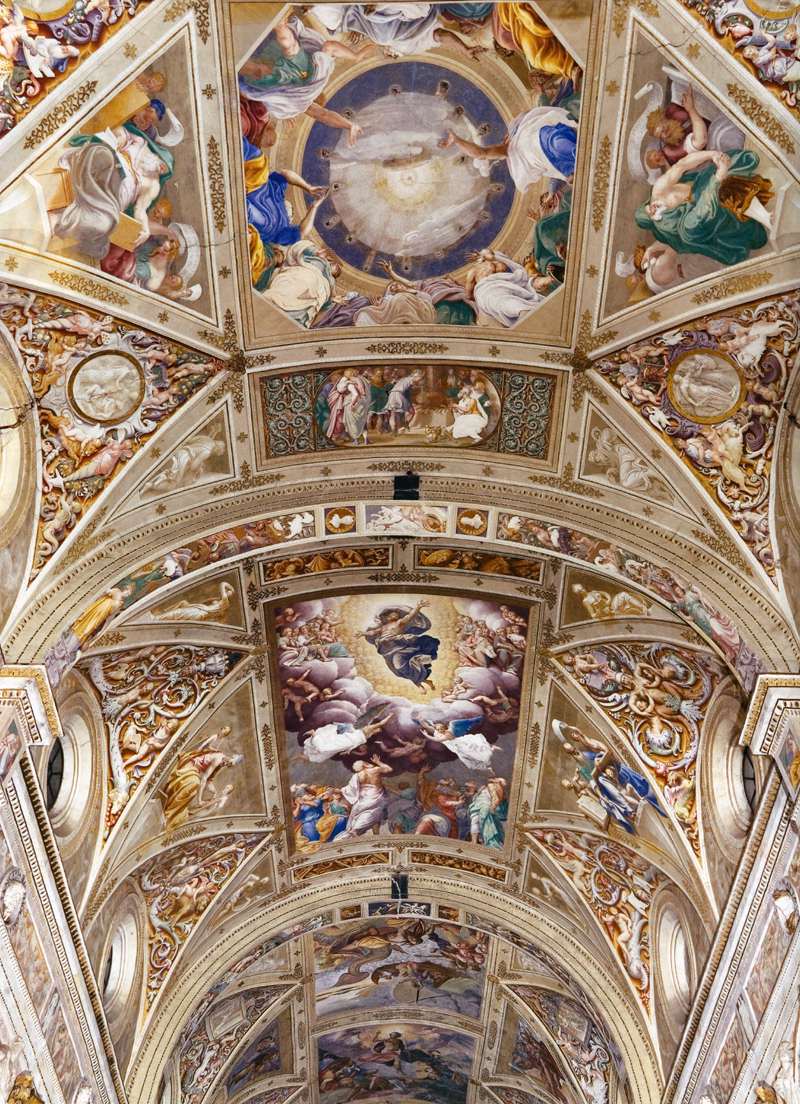
The Ascension of Christ

About the Artist

Bernardino Gatti

14951576

Italian painter. In some documents he is said to have come from Pavia. His first documented work, the Resurrection (1529; Cremona Cathedral), shows that he had a thorough knowledge of Correggio 's work and of the classicizing manner of Raphael and Giulio Romano. Correggio's influence became increasingly apparent, although it was blended with Lombard archaisms, as in the Virgin of the Rosary (1531; Pavia Cathedral) and in the Resurrection with the Virgin and St John the Baptist and the Last Supper (1534-35; both Vigevano Cathedral). In the frescoes of St George and the Dragon and scenes from the Life of the Virgin (1543; both Piacenza, Santa Maria di Campagna) he tried to refine his style further, still drawing on Giulio and Correggio but achieving only a somewhat bloodless sentimentality. This is evident in the Crucifixion (Piacenza, Municipio). By 1543 he was working in Piacenza, where he completed Pordenone's frescoes in the dome of a church. He moved to Cremona six years later, where his commissions included a large religious fresco of 1552, notable for its vividly naturalistic portraits of contemporary noblemen in the guise of biblical characters. From 1560 to 1572, assisted by Bartholomaeus Spranger, Gatti worked in Parma on a prestigious commission to decorate the cupola of a major church. In the following year he returned to Cremona in order to paint a high altar for the city cathedral, but he died before finishing it.

View all works →