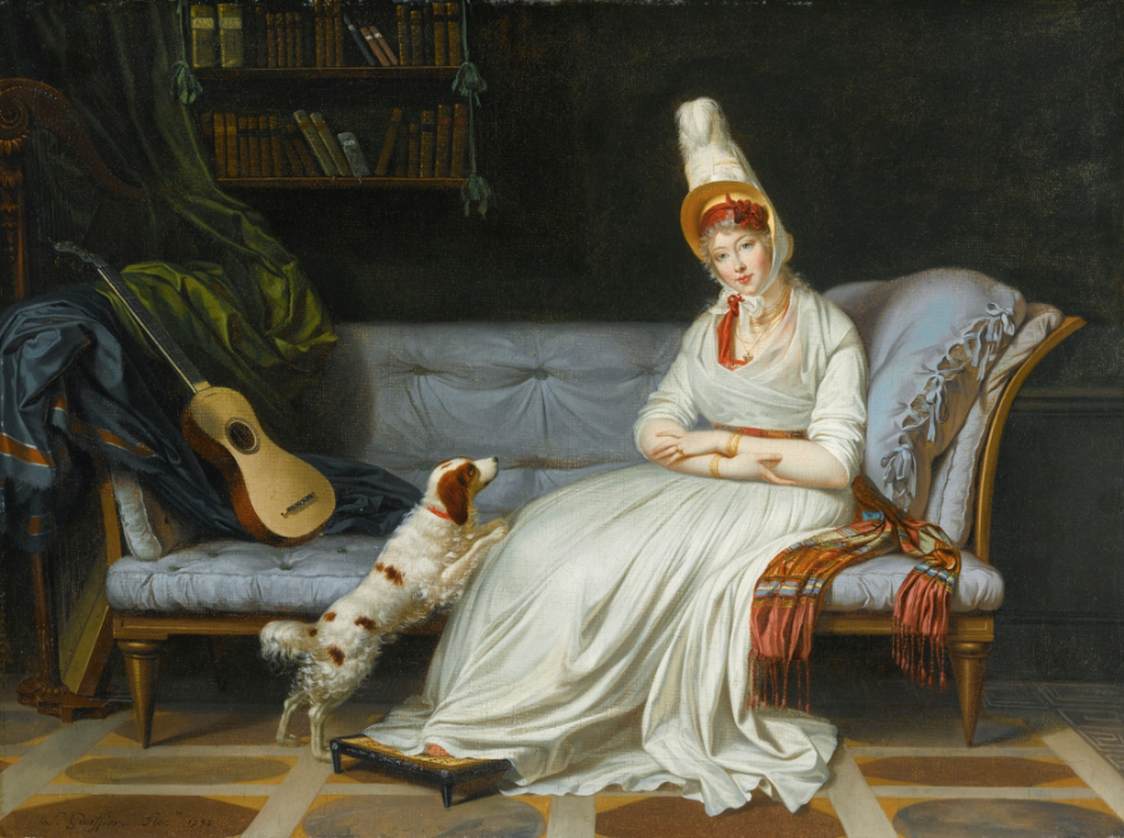
Louis Gauffier
1762 – 1801
French painter. Following his move to Paris, where he became a pupil of Hugues Taraval (1729-1785) and a student at the Académie Royale, in 1784 Gauffier shared the Prix de Rome with Jean-Germain Drouais and Antoine-Denis Chaudet (for sculpture), his own work being Christ and the Woman of Canaan (École Nationale Supérieure des Beaux-Arts, Paris). During his time in Rome (1785-89) Gauffier worked hard, but his health was poor and the results variable. On his return to Paris he was accepted (agréé) by the Académie as a history painter. Soon after, he returned to Rome in order to escape the worsening situation in Revolutionary Paris, although he continued to send his Neo-classical works to the Salon. In March 1790 he married Pauline Chatillon (d July 1801), a portrait painter whom he and Drouais had taught. After the execution of Louis XVI, Gauffier painted a wide breadth of history subjects, a practice central to Neo-classicism which he embraced readily. The artist's masterful composition Cleopatra and Octavian (1788, National Gallery of Scotland) is a scene taken from Plutarch's Life of Marc Anthony, Gauffier's Pygmalion, from myth. The artist not only embraced classicised story-telling, but Neo-classicism's other tenets as well. Colours were bright and primary; he employed a strong Poussinesque palette in contrast to the more sombre tones of his contemporaries. Distinct architectural elements litter his works and Gauffier's landscapes were adept topographical views of the Tuscan campagna. Gauffier never returned to France (after a brief trip in 1789); he remained in Rome from 1784 until French citizens were forced to leave the capital in 1793. Though not on the formal list of émigrés, the artist, initially excited by the new freedom to exhibit at the Salon the revolution provided, was forced to move his wife and young family to Florence after being branded a royalist. However it was not Gauffier's early death age thirty-eight that makes history painting by the artist rare: the artist was forced in Florence to turn to portraiture and landscape painting in order to earn a living. Though adept at both the later genres, Gauffier's potentially extraordinary and long career as a history painter was cut short by the storm of contemporary events.
View all works →