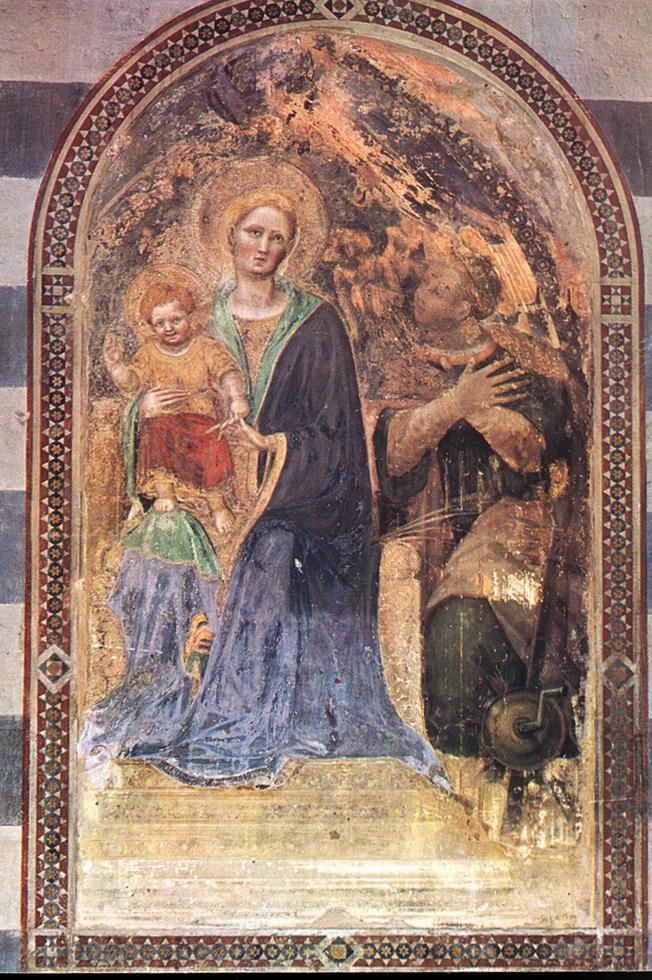
Gentile Da Fabriano
1370 – 1427
Italian painter. Originally named Gentile di Niccolò di Giovanni di Massio, he was named after his birthplace, Fabriano in the Marches. He was the most important Italian representative of the elaborate Late Gothic (International Gothic) style of painting that dominated European painting around 1400. He was a consummate master of naturalistic rendering, narrative invention and detail, and ornamental refinement. He introduced a new relationship between painting and nature through the depiction of three-dimensional space and the representation of natural lighting. This relationship, established at the same time but in much more radical form by Masaccio, was central to the art of the Renaissance. He carried out important commissions in several major Italian art centres and was recognized as one of the foremost artists of his day, but most of the work on which his great contemporary reputation was based has been destroyed. It included frescos in the Doges' Palace in Venice (1408) and for St John Lateran in Rome (1427). In between he worked in Florence, Siena, and Orvieto. His major surviving work is the celebrated altarpiece of the Adoration of the Magi (Uffizi, Florence, 1423), painted for the church of Santa Trinita in Florence, which places him alongside Ghiberti as one of the greatest exponents of the International Gothic style in Italy. It is remarkable not only for its exquisite decorative beauty but also for the naturalistic treatment of light in the predella, where there is a night scene with three different light sources. Gentile had widespread influence (much more so initially than his great contemporary Masaccio), notably on Pisanello, his assistant in Venice, Jacopo Bellini, who worked with him in Florence, and Fra Angelico, who was his greatest heir.
View all works →