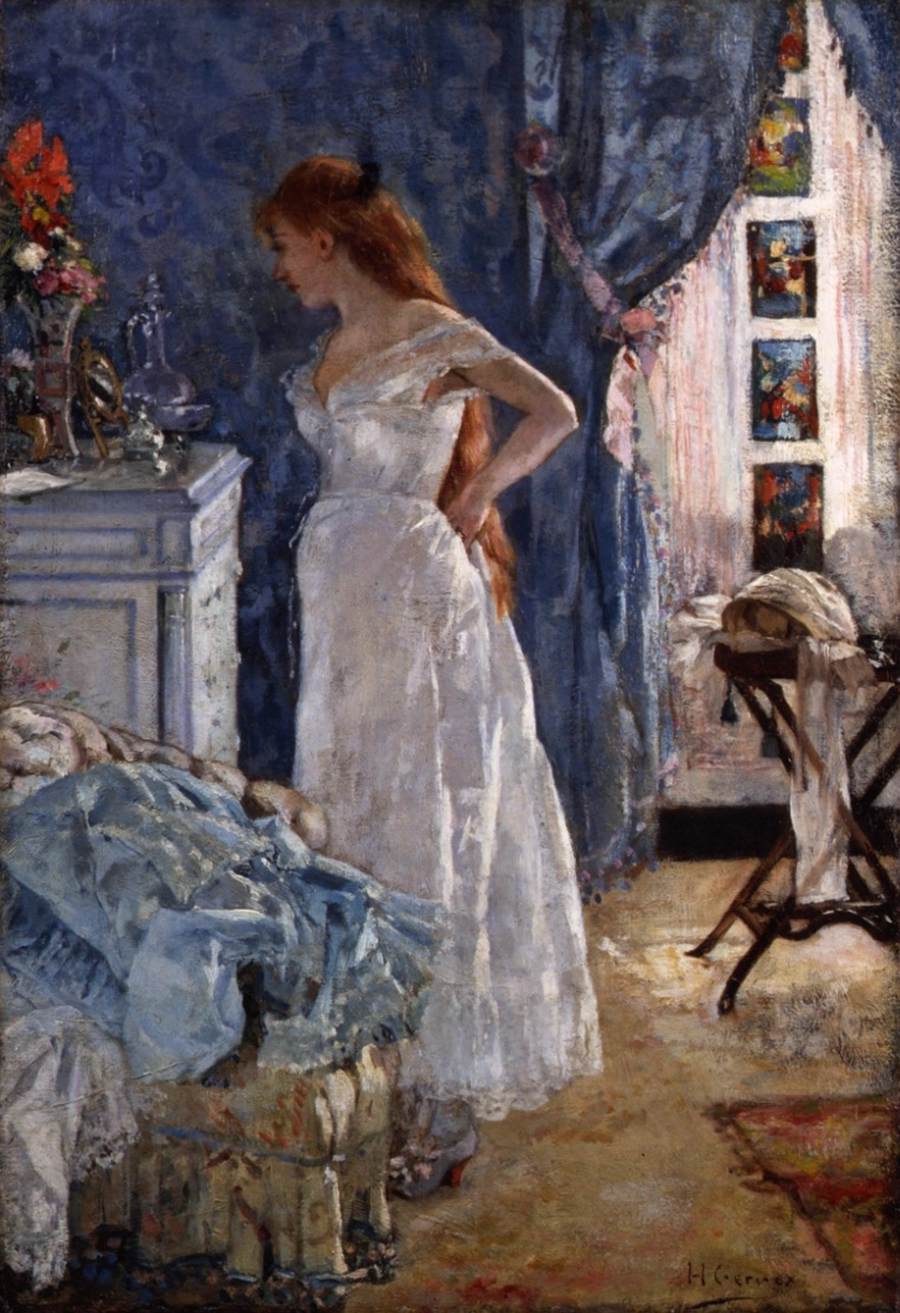
Henri Gervex
1852 – 1929
French painter. His artistic education began with the Prix de Rome winner Pierre Brisset (1810-1890). He then studied under Alexandre Cabanel at the École des Beaux-Arts in Paris, where his fellow pupils included Henri Regnault, Bastien-Lepage, Forain, Humbert (1842-1934) and Cormon; and also informally with Fromentin. Gervex's first Salon picture was a Sleeping Bather (untraced) in 1873: the nude, both in modern and mythological settings, was to remain one of his central artistic preoccupations. In 1876 he painted Autopsy in the Hôtel-Dieu (untraced), the sort of medical group portrait he repeated in 1887 with his Dr Pean Demonstrating at the Saint-Louis Hospital his Discovery of the Hemostatic Clamp (Musée de l'Assistance Publique, Paris), which celebrated the progress of medical science with a sober, quasi-photographic realism. Gervex's most controversial picture was Rolla (1878; Musée des Beaux-Arts, Bordeaux), refused by the Salon of 1878 on grounds of indecency, partly because of the cast-off corset Degas had insisted he include. The painting shows the central character in a de Musset poem, Jacques Rolla, who, having dissipated his family inheritance, casts a final glance at the lovely sleeping form of the prostitute Marion before hurling himself out of the window. As his friend, Manet , had done the year before with his rejected Nana, Gervex exhibited his work in a commercial gallery, with great success. In 1883 he decorated the town hall in the 19th arrondisement and of the Opéra Comique. In 1889 and 1900 he was member of the Jury at the World Fair, he argued in favour of giving the Impressionists their due recognition. In 1904 he executed a cycle of frescoes for the town hall in Neuilly. Gevex was a favourite Salon painter, whose range of subjects included female nudes, portraits, and society scenes.
View all works →