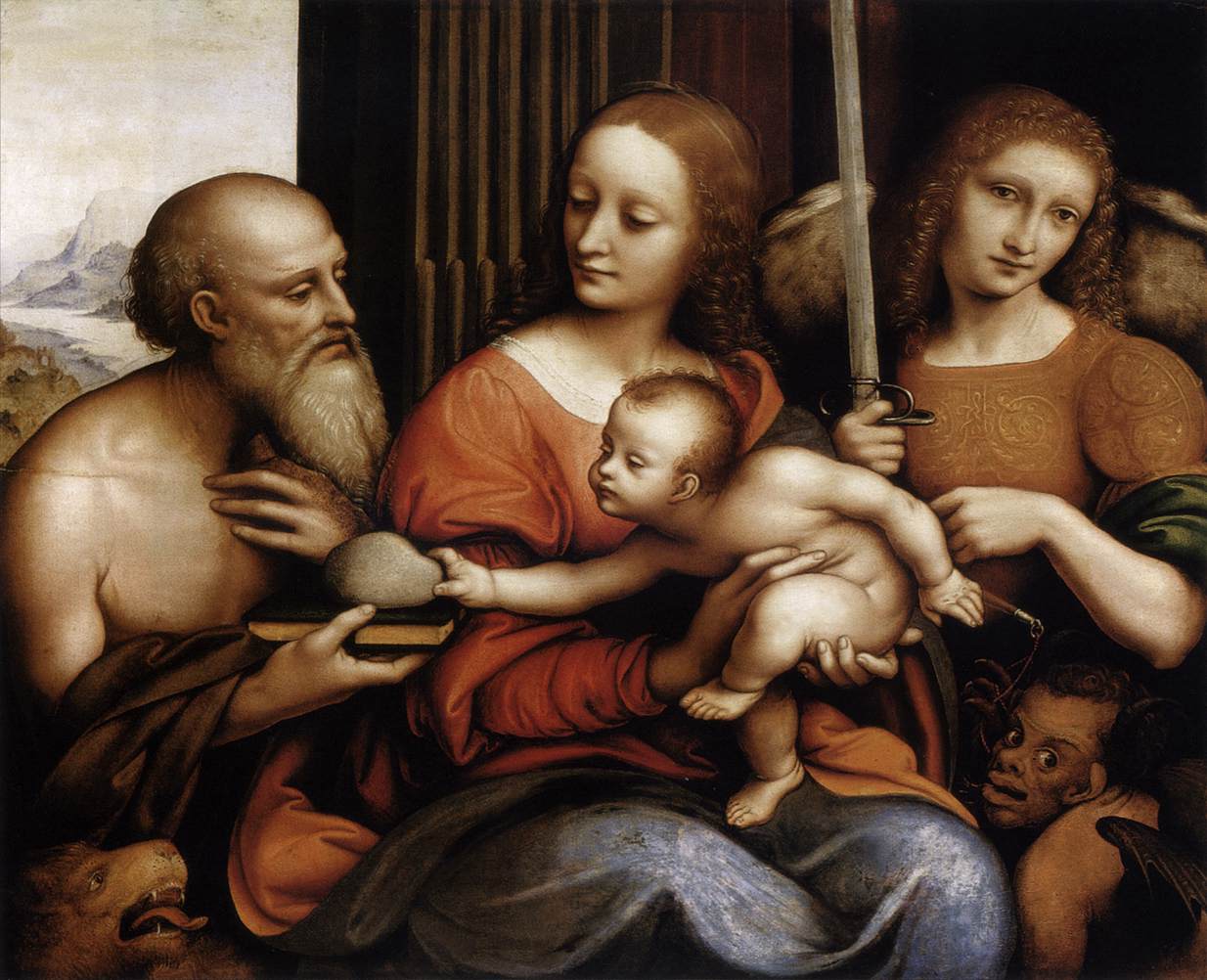
Giampietrino
Italian painter, his real name: Giovanni Pietro Rizzoli. He may be identifiable with the 'gian petro' jotted down in a list by Leonardo between 1497 and 1500 (Milan, Biblioteca Ambrosiana, Codex Atlanticus) and thus may have been present in or near Leonardo's Milanese workshop before the end of the 15th century, although the surviving paintings usually connected with him belong stylistically to the period between 1510 and 1530. The recent discovery of documents and paintings related to his presence in Savona in 1537 excludes the previous identifications of the artists with Giovanni Pedrini or Pietro Rizzo. His paintings include the altarpiece of the Virgin and Child with Saints dated 1521 for the church of S Marino, Pavia, and a series of small pictures of the Virgin and Child, Mary Magdalene, Lucrezia, Cleopatra, Sophonisba and Diana (the latter New York, Metropolitan Museum), probably almost all privately commissioned. These paintings are strongly influenced by the work of Leonardo, often deriving, with variations, from his lost Leda or from other late drawings and compositions by Leonardo, thus suggesting a close relationship of the artist with Leonardo during the latter's second Milanese period (mid-1508-1513). Giampietrino's technique is generally refined and precise, his pale flesh tones barely tinged with pink. The intense, luminous colours of the draperies often contrast with dark backgrounds depicting rocky landscapes, also reminiscent of Leonardo. Many replicas and copies of his works exist, for example the painting (Verona, Castelvecchio) by Gian Francesco Caroto after his Sophonisba (Isola Bella, Museo Borromeo). The autograph paintings, however, are characterized by a small white vase that may be the symbolic signature of the artist. His work also shows the influence of Bernardino Luini 's paintings of the second and third decades of the 16th century. Three drawings are securely attributable to Rizzoli: a study for the Pavia altarpiece (Paris, Louvre), a cartoon of the Holy Family (New York, Pierpont Morgan Library) and a large preparatory study for a Mary Magdalene (study and painting both Milan, Castello Sforzesco). Giampietrino's art, with its ambiguous balance between religious asceticism and subtle but quite evident eroticism, was highly successful in the early 17th century in Lombardy. Its influence can be traced in the works of Giulio Cesare Procaccini and Daniele Crespi.
View all works →