Massimo Taparelli, Marquis d' Azeglio
1798 – 1866
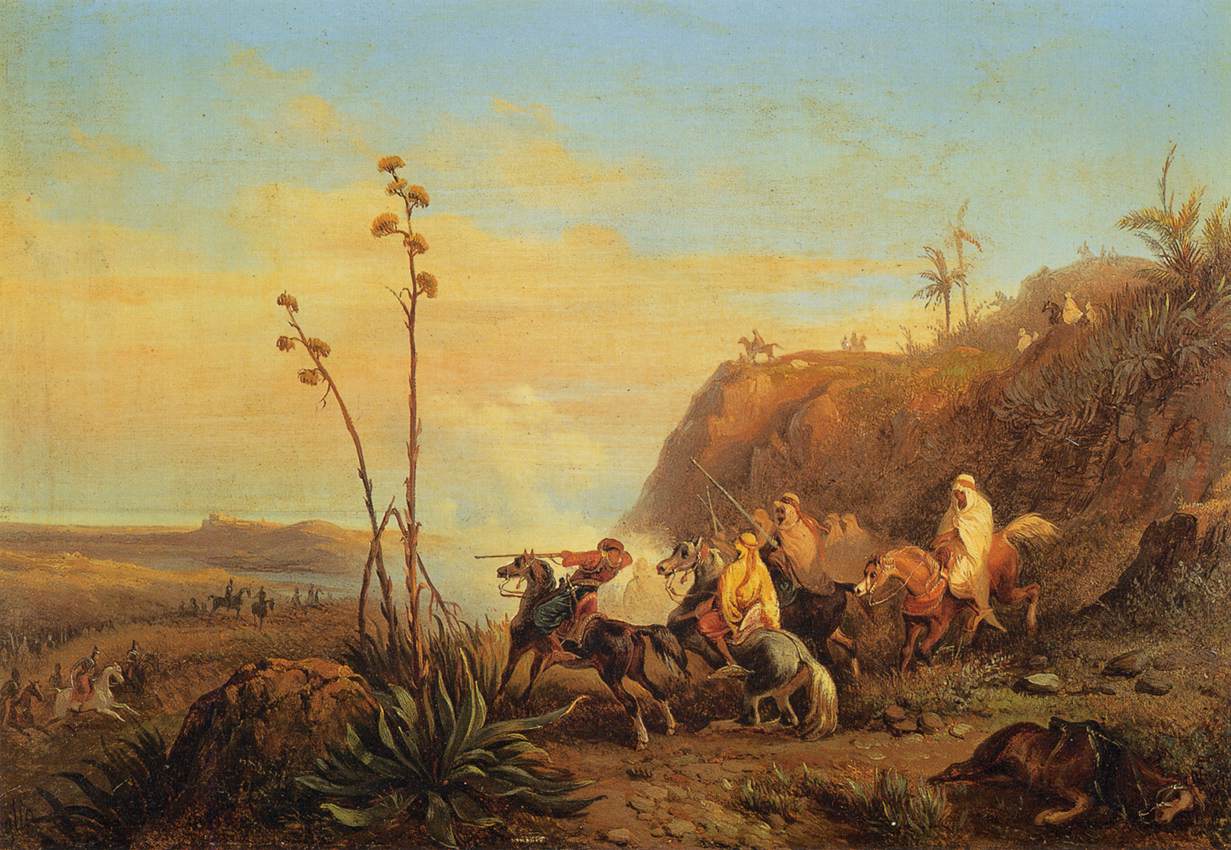
Italian painter, writer and statesman. After visiting Rome in 1814, he lived there intermittently between 1818 and 1828. Until 1820 he trained under Martin Verstappen (1773-1853) and then spent extended periods in the Roman Campagna, sketching and painting numerous landscapes, such as Wood and Glade, Alban Hills (Turin, Galleria Civica d'Arte Moderna), which display a lingering 18th-century vocabulary and a northern European taste for detail. In an effort to reconcile his interests as artist, writer and patriot, D'Azeglio began to adapt landscape motifs to heroic scenes from romantic literature and history (especially battles). In the Death of Montmorency (1825; Turin, Galleria Civica d'Arte Moderna), a subject taken from a romantic novel by Sophie Cottin (1770-1807), he set out to innovate traditional Netherlandish landscape by substituting knights and paladins for rustic figures. He made a fundamental contribution to the development of history painting in Italy by using his subjects to evoke patriotic sentiment. The Duel of Barletta (1831; private collection) depicts in a conventional manner an episode of 1503 of Italian romantic heroism, which D'Azeglio used again in a celebrated novel of 1833. His reputation rests primarily on his small landscape pictures - endowed with a new intensity in later years - for they prepared the way for the naturalistic expressions of Romantic landscape painting in Piedmont.
View all works →