Benozzo Gozzoli
1420 – 1497
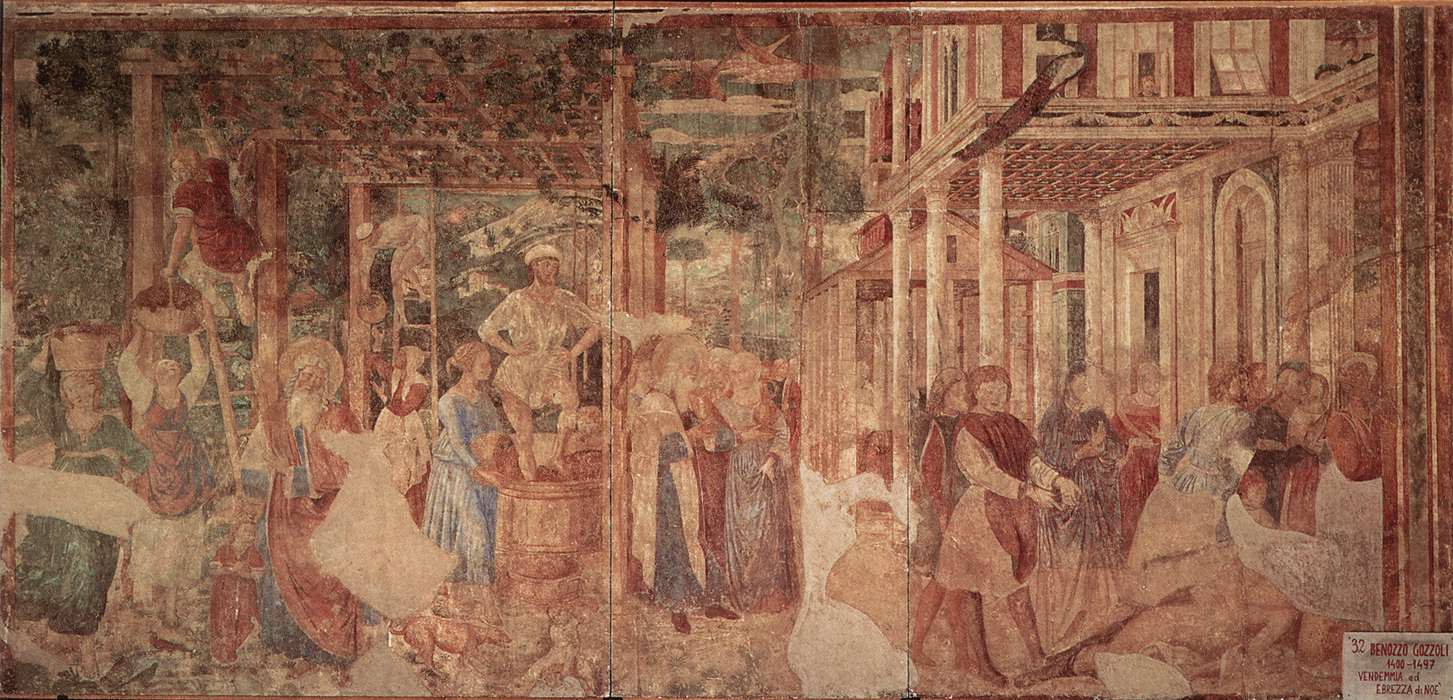
Early Italian Renaissance painter. He was the son of the tailor Lese di Sandro, his original name is Benozzo di Lese di Sandro. His father was from a citified branch of a family of farmers. The name Gozzoli, which though absent from the 1550 edition of Vasari 's Lives, appeared in that of 1568 comes from the name "Ghozzolo" common in the other branch of the family, the one that had remained in the country. Gozzoli's formative collaborations included those with Lorenzo and Vittorio Ghiberti on the third bronze door of the Baptistery, Florence (1444), with Fra Angelico on the pictorial decoration of the Dominican convent of San Marco in Florence (1444-45), with Fra Angelico on some frescoes in the chapel of Pope Nicholas V in the Vatican (1447), and again with Fra Angelico on the ceiling of the Chapel of San Brizio in the cathedral at Orvieto (1448). In 1450, he was in Montefalco in Umbria where his first independent works were executed. He left frescoes in the church of San Fortunato and produced a panel painting of the Madonna della Cintola for the high altar (now in the Pinacoteca, Vatican). For the church of S. Francesco, the Franciscans commissioned from him the fresco cycle with Scenes from the Life of St Francis (1450-52). At Viterbo he painted nine frescoes of scenes from St Rose's life (after 1453), which were lost during the course of extension work in the church in 1632. Between 1456 and 1459, Benozzo put in an irregular appearance in various places in Central Italy. He painted an altarpiece at Perugia for Collegio Gerolominiano (1456); at Sermoneta he painted a Madonna in Glory for the cathedral (1458). He was in Rome in 1458, working on the displays (flags and standards) for the coronation ceremony of Pius II. In Rome he also frescoed the Albertoni chapel in Santa Maria d'Aracoeli of which a St Anthony of Padua survives. In 1459 Benozzo was summoned to Florence by the city's most illustrious patrons, the Medici, to carry out the prestigious commission - the most important of his career - of decorating the walls of the chapel in their palace. The subject chosen was the Journey of the Magi which he used to portray various members of the Medici family, with its young princes handsomely, even flamboyantly dressed and all set against a wonderful landscape, creating a fairy tale of the Renaissance (1459-60). In 1461, he produced the altar painting of a Sacra Conversazione for the Compagnia delle Purificazione in Florence. The painting has since been taken apart and is kept in various museums. By 1463 he was working at San Gimignano on a cycle of 17 scenes from the life of St Augustine in the choir of Sant'Agostino (last scene signed and dated 1465) and on a fresco of St Sebastian (1464). In 1467 he painted the Tabernacle of the Executed, and the Shrine of the Visitation, the detached frescoes are now on display in the Palazzo Pretorio, Certaldo, and in the Biblioteca Comunale, Castelfiorentino, respectively. In 1471 he executed a panel painting of the Triumph of St Thomas Aquinas (now in the Louvre, Paris), in 1484 the Shrine of the Madonna delle Tosse, the detached frescoes of which can be seen also in Castelfiorentino. Between 1469 and 1485, he painted his most extensive commission, a series of 25 frescoes of Old Testament scenes for the Campo Santo (cemetery), Pisa. In 1944 a bombing raid, followed by a fire, destroyed or damaged the greater part of the frescoes. Forced to leave Pisa, along with other Florentine residents of the city, following the invasion by Charles VIII and the expulsion of the Medici, Benozzo returned to Florence. He is in Florence in 1497 but sometime during the year he moved to Pistoia where his sons were already working. He had probably been summoned there by the city government to fresco a large Maestà in the City Hall. Benozzo died in Pistoia on October 4, 1497, probably of plague, and was buried in the cloister of the convent of San Domenico.
View all works →