FINDART

Interior of the Choir in the Capuchin Church on the Plazza Barberini in Rome

1818 · The Hermitage, St. Petersburg

interior

This painting, which Granet first created in 1815, became so popular that he produced some 15 replicas, the first of which he presented to Russian Emperor Alexander I during his visit to Paris. The subject, customary already in the eighteenth century, enabled the artist to demonstrate the virtuosity in conveying light, which he had attained by intensive study of nature in Provence and Italy.

Loading map…
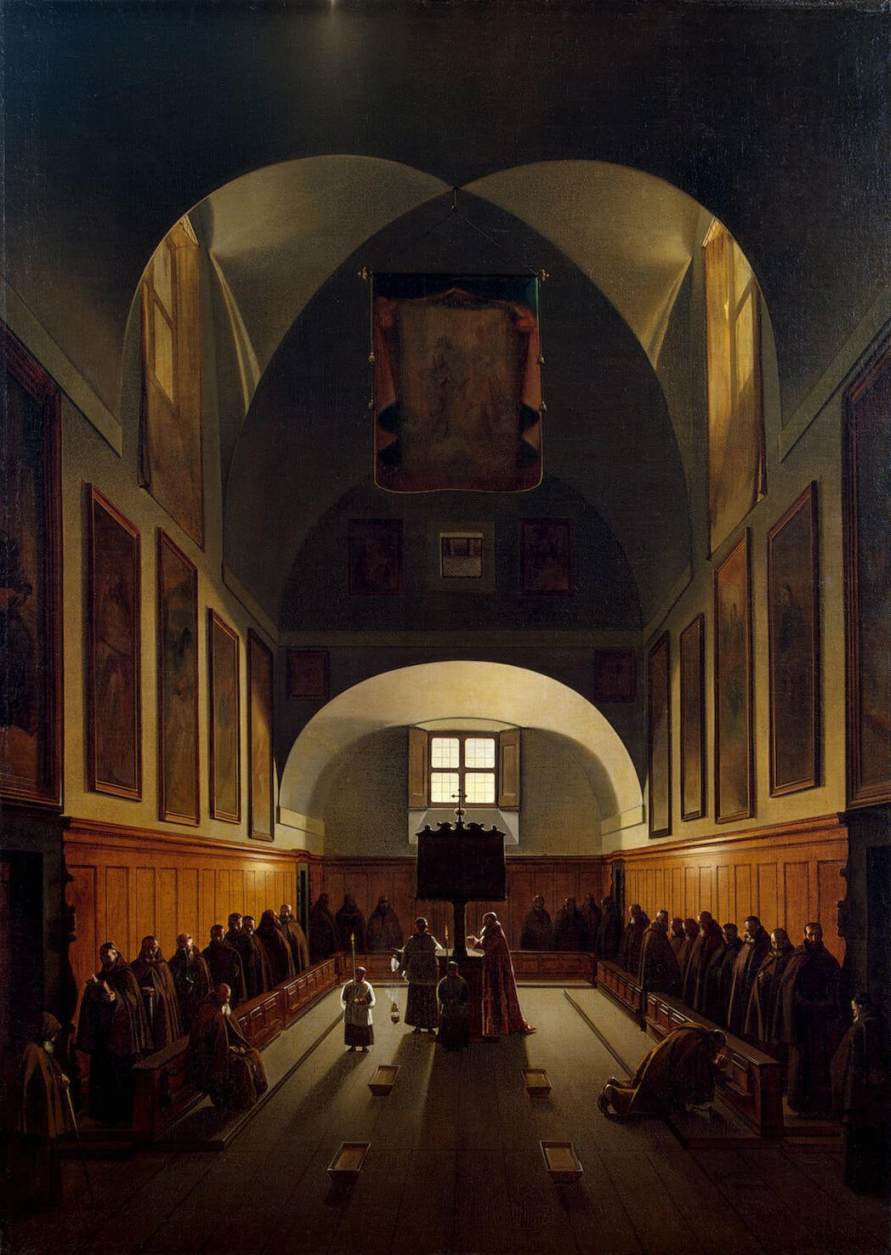
Interior of the Choir in the Capuchin Church on the Plazza Barberini in Rome

About the Artist

François-Marius Granet

17751849

French painter, a pupil of Jacques-Louis David. In 1793 he left Aix with the local Société Populaire to assist in the siege of Toulon. He worked as a draughtsman with the artillery battery; his autobiography provides a vivid account of his experiences during the siege and destruction of the town. On a subsequent tour of duty he was employed to paint republican motifs on ships in the naval base at Toulon. Granet spent the years 1802-19 in Rome. Here he earned his living selling drawings of ancient monuments and painting biographical events from the lives of famous artists. He made a speciality of sombre tonal effects and changing light in dimly lit interiors, his highly individualistic style recalling Dutch interiors rather than the Neoclassical tradition in which he was trained. His Choir of the Capuchin Church in Rome was exhibited at the 1819 Salon with such success that he made sixteen replicas of it. Granet also painted Italian landscapes, constructed with firm, cubic volumes in which some critics have seen a foreshadowing of Cézanne. He reached the height of his success when he was awarded the Cross of the French Legion of Honour and the ribbon of the Order of Saint Michael. In 1826 he became curator of the Louvre Museum and was made Keeper of Pictures at Versailles in 1830. During the Revolution of 1848 he retired to his native Aix-en-Provence, where he founded the museum which bears his name. It contains a celebrated portrait of him by Ingres.

View all works →