Willem Claesz. Heda
1594 – 1680
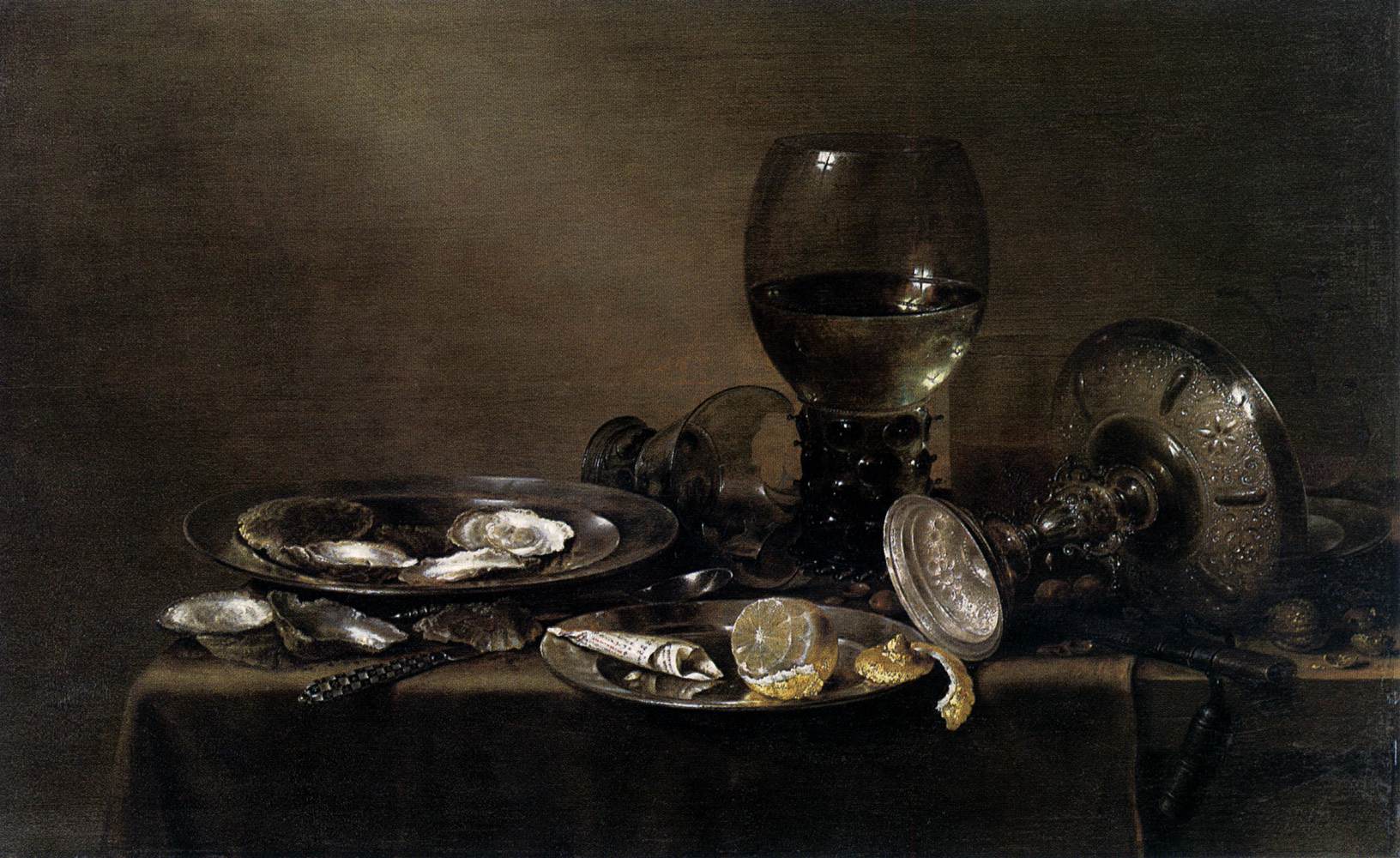
Heda's earliest dated work is a Vanitas (1621; The Hague, Museum Bredius), which shows a still-life from a high viewpoint, composed of various objects bearing vanitas associations (e.g. a bowl of glowing embers, smoker's requisites, an overturned glass and a skull); the colouring is in brownish-grey tones and represents one of the earliest examples of a Dutch monochrome still-life ('monochrome' refers to the range of tones, rather than of colours). Even in this early work Heda's skill at painting textures is evident. A more balanced composition is achieved in another Still-life (1629; The Hague, Mauritshuis) and in the Breakfast Table (1631; Dresden, Gemäldegalerie), in both of which the objects, set against a neutral background, are linked by a strong diagonal. In 1631 he became a member of the Haarlem Guild of St Luke (of which he served as deacon on several occasions after 1637). After 1640 Heda's compositions became larger, richer, and more decorative (e.g. the still-life in the Hermitage, St. Petersburg). To obtain a more monumental effect, during his maturity Heda often abandons the traditional horizontal format for a vertical one. Ornate silver vessels and costly Venetian glasses intensify the contrasts of 'valuers', and touches of colour provided by the pink of sliced hams and ripe fruit are combined with an increased chiaroscuro. The monochromatic style was also practiced by Heda's son Gerrit Willemsz Heda (before 1637-c. 1702), who worked closely in his father's manner.
View all works →