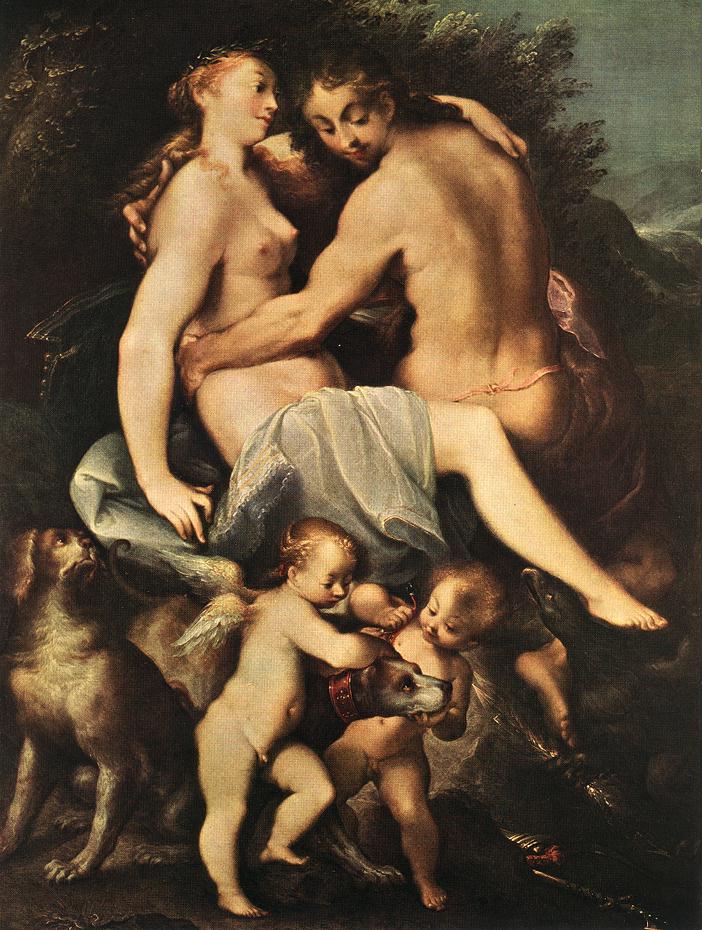
Joseph the Elder Heintz
1564 – 1609
Swiss painter, draughtsman, architect and artistic adviser, member of a family of artists, son of Daniel Heintz, an architect-mason. He began his training as a painter c. 1579 with Hans Bock I (c. 1550-c. 1623) in Basle. His first surviving drawings (1580) show something akin to Holbein 's manner in his stained-glass window designs. After completing his apprenticeship he went c. 1584 to Rome, where he joined a circle of German and Netherlandish artists. He also studied ancient art and copied paintings by Renaissance artists such as Raphael, Michelangelo, and Polidoro da Caravaggio. In 1587 he traveled to Florence and Venice, absorbing the styles of Tintoretto, Titian, and Paolo Veronese. In autumn 1591 the Holy Roman Emperor Rudolf II summoned him as portraitist and court painter' to Prague but soon sent him back to Italy, where he drew ancient statues in addition to producing his own work and acting as art agent for the Emperor. In 1592-95 he stayed mainly in Rome, then returned to Prague. In the following years he worked indefatigably as a draughtsman, painter, architect and artistic adviser, moving between Augsburg and Prague. Heintz's paintings included religious images, portraits, and, following the emperor's taste, erotic mythological themes. Agitated figures, shallow depth, and a cool-toned, colourful palette characterize his very personal style. Heintz spent his later career primarily as an architect, mainly in Augsburg and Prague. He designed the east façade of Augsburg's new customs house, basing his architectural forms on his father's ideas and on contemporary architecture in Rome, Venice, and Lombardy.
View all works →