Johan Barthold Jongkind
1819 – 1891
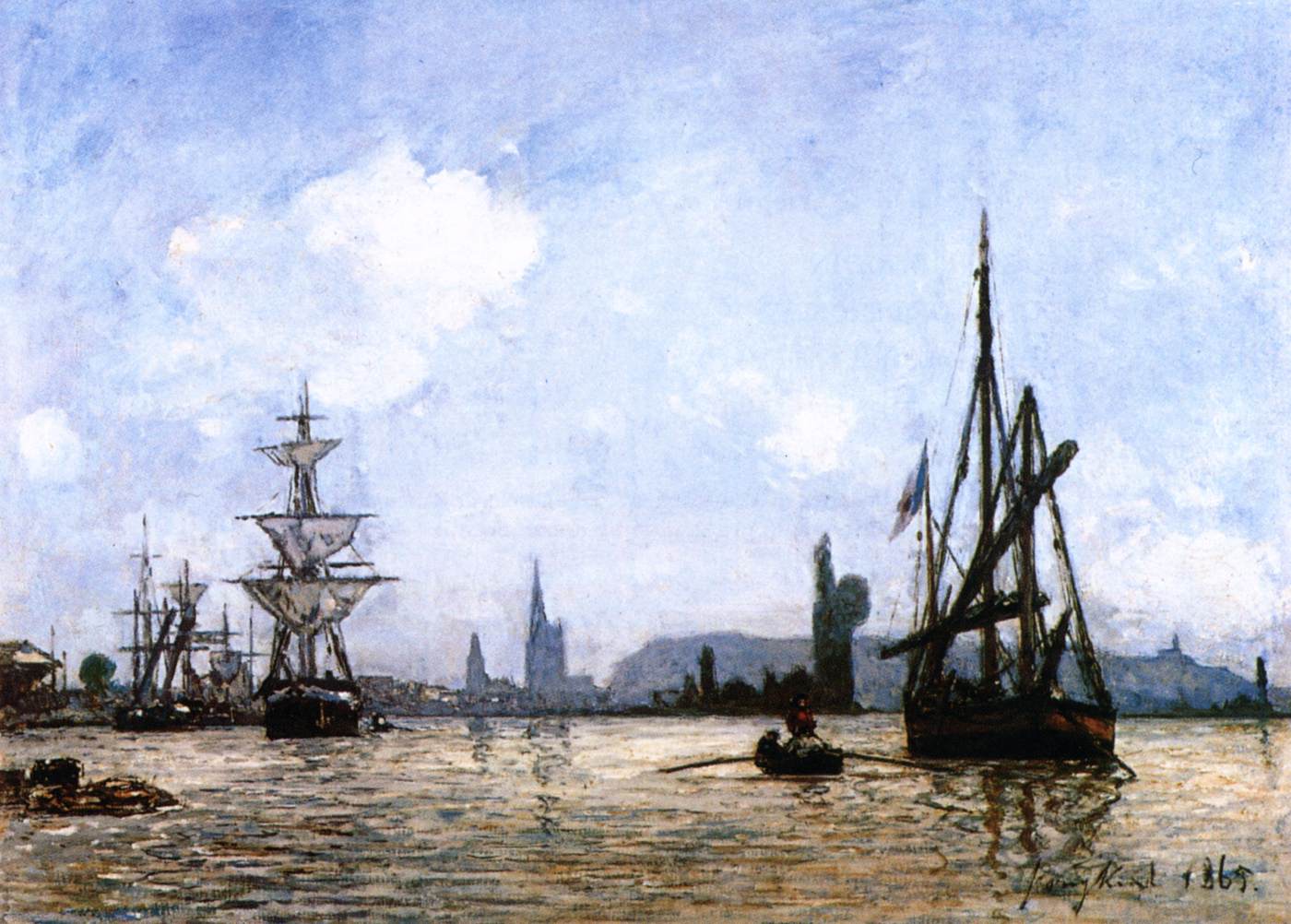
Dutch painter and printmaker. After training and working briefly as a notary's clerk, he studied from 1836 at the Academie voor Beeldende Kunsten in The Hague, where he befriended Charles Rochussen and was especially influenced in his watercolour technique by the work of the Director, Andreas Schelfhout. Among his early wash drawings, Embarkation (1844; The Hague, Gemeentemuseum) provides evidence of a developed sense of this medium. In 1854, in response to a request from Comte Emilien de Nieuwerkerke, Schelfhout proposed Jongkind as a young Dutch artist who might profit from going to Paris to study in the studio of Eugène Isabey; Jongkind therefore accompanied Nieuwerkerke to Paris and was based there for the next ten years. His work during this period embraced oil painting of a sometimes markedly traditional Dutch character. Jongkind also made sketching trips away from Paris, especially during the early 1850s, returning to Dutch settings to paint, and also sketching frequently on the coasts of Brittany and Normandy, where the strong Atlantic light prompted some of his best watercolour work up to that point. In 1860 he becomes acquainted with a Dutch painter, Mrs Joséphine Fesser, with whom he falls in love and who will become his partner. In 1862, Jongkind gets acquainted with Boudin and Monet , with whom he goes painting to Le Havre. Every summer, Jongkind returns on the Norman Coast, between Trouville and Honfleur. There, a deep change takes place in his work, points of view are getting larger and more diversified, and the subtile game of light becomes the central element of his paintings and watercolours. It is this Norman period of Jongkind which situates him as the precursor of Impressionism. In 1868, Jongkind makes a series of Demolitions in Paris (watercolours and oils), far from merchant streets and touristic boulevards, where he represents men and horses at work. The Franco-Prussian war of 1870 drives Jongkind far from Paris, in Nantes then in Nevers. In 1878 he settled in la Côte-Saint-André, a small village in the Dauphiné area near Grenoble where he lead a quiet life until his death in 1891.
View all works →