Miklós Barabás
1810 – 1898
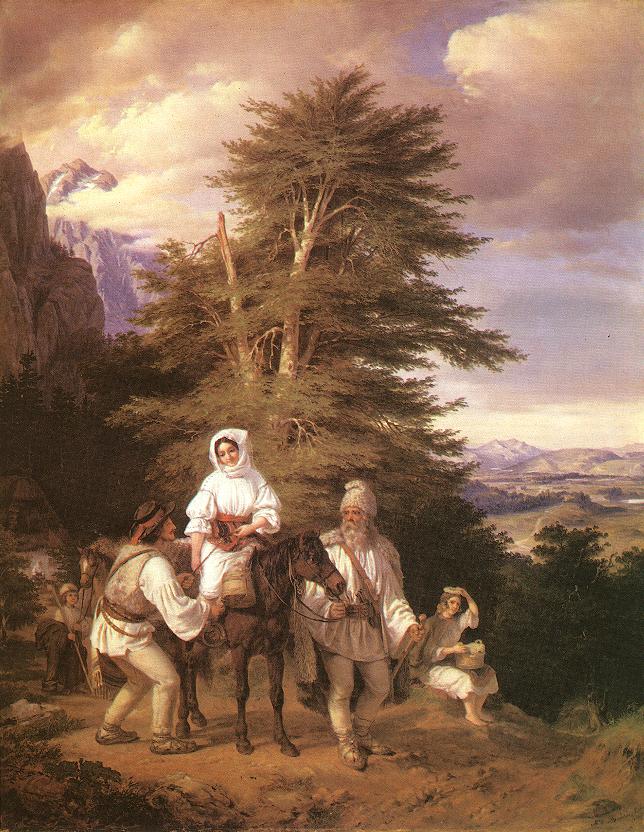
Hungarian painter. He attended the protestant school of Nagyenyed. He began painting portraits at a young age. He was a pupil of Johann Ender in Vienna for a short time in 1829. After returning to Kolozsvár in 1830, he learnt lithography from Gábor Barra and produced lithographs of particularly high artistic standard all through his life. After spending two years in Bucuresti from 1831, he became a fashionable portrait painter. His study tour in Italy during 1834-1835 proved to be highly fruitful. He took over the technique of painting water colour from W. L. Leitch, an English painter, as well as a novel portrayal of nature. While in Venice, Italy, he copied Veronese's The Rape of Europe, which brought him a good deal of success in Pest in 1835. Except for shorter periods, he lived in Budapest from that time onwards. He played an important role in establishing Pest as an art centre. Eventually, he was the first Hungarian painter who managed to live by means of art which was largely due to the fact that he was a master of portrait painting. His portraits include practically all of his great contemporaries, e.g. István Széchenyi, Lajos Kossuth, Sándor Petõfi, and József Bem, etc. The portraits of Franz Liszt and Mrs István Bittó (1874) are second to none in character portrayal. His greatness lies in this genre, in fact. His elaborate oil paintings, drawings and water colours are characterized by empathy and delicate colouring. As for group portrayal (Mrs Bencsik with her Family, 1840, The Three Little Daughters of the Artist, 1849) it lacks in composition and drawing. In spite of the picturesque qualities, the picture A Rumanian Family Leaving for the Market is somewhat formal. As for his landscapes in watercolour, the beautiful countryside of the Hungarian plain is touchingly depicted (Countryside with Draw Well, etc.). Of his genre pictures with a biedermeier atmosphere, the picture Pigeon Post (1840), which he painted several times, is an outstanding one. During absolutism, he had to face financial problems, forcing him to take photos and to paint altars for some time. As a result of his struggle, the Art Society was established in 1859, of which he was the President from 1862 until his death. In 1867 he became a Member of Parliament of Pest in 1867. His Authobiography is a lively document of his own life and activites, as well as that of social and cultural conditions of his time.
View all works →