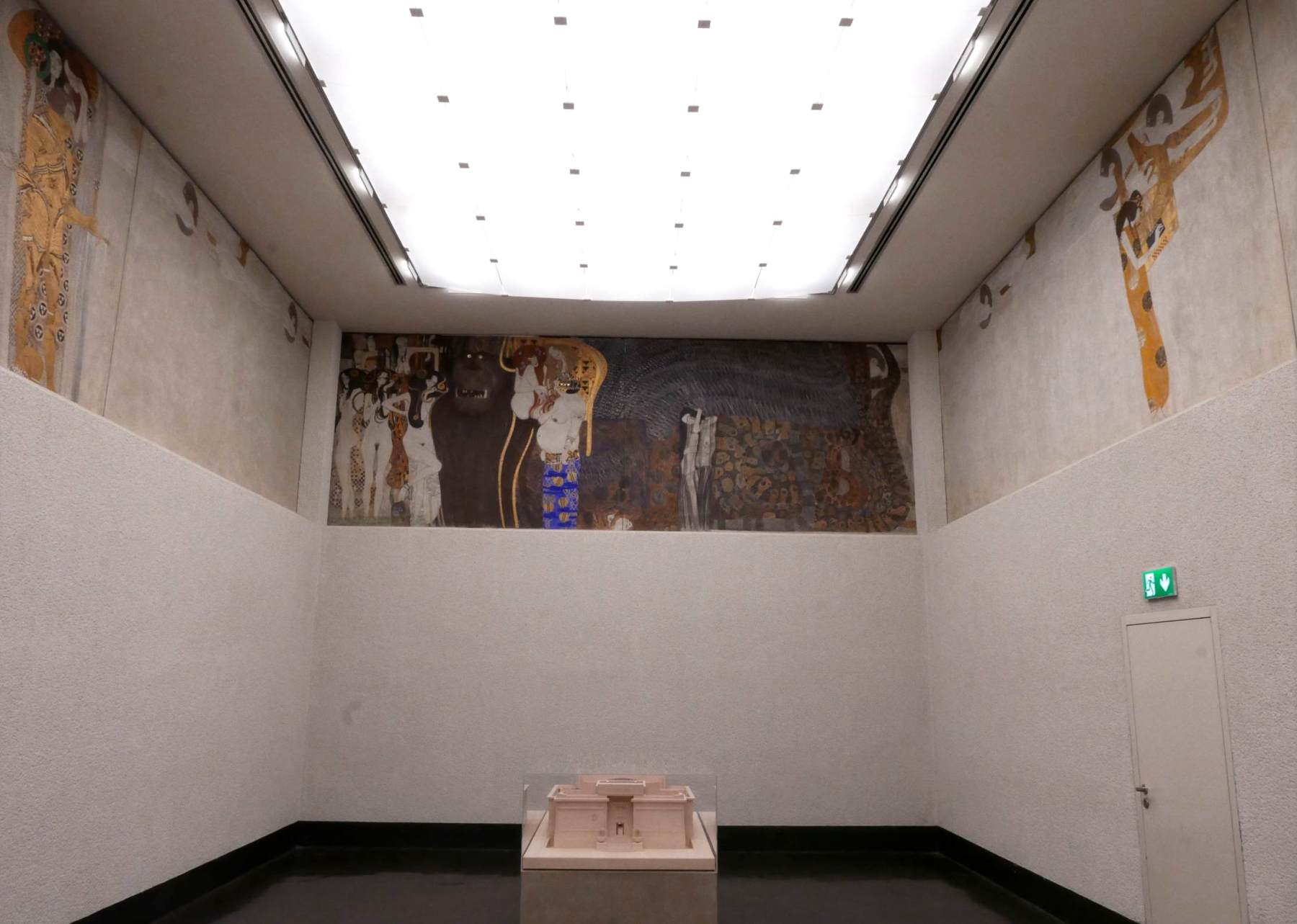
Beethoven Frieze (view of the room)
1902 · Secession Building, Vienna
otherDiscouraged by the storm of public protest which greeted his paintings for the Aula of Vienna University, Klimt laid aside work on this increasingly unrewarding commission to devote himself to his only true fresco, his Beethoven Frieze (1902; Secession Building, Vienna; restored 1985). Painted for the 14th Secession exhibition (1902), the frieze was intended as part of the group's homage to the Leipzig artist Max Klinger, whose polychrome sculpture, the Beethoven Monument (Museum der Bildenden Künste, Leipzig), formed the centrepiece of the show. The centre wall (The Hostile Powers, the Titan Typhoeus, the Three Gorgons) was conceived as a pictorial paraphrase of the final movement of Beethoven's Ninth Symphony and depicted the struggle for happiness undertaken by a knight in armour who, vanquishing the 'hostile powers' (the giant Typhon, the three Gorgons, disease, insanity and death), leads 'weak humanity' into the realm of the arts.