Gustav Klimt
1862 – 1918
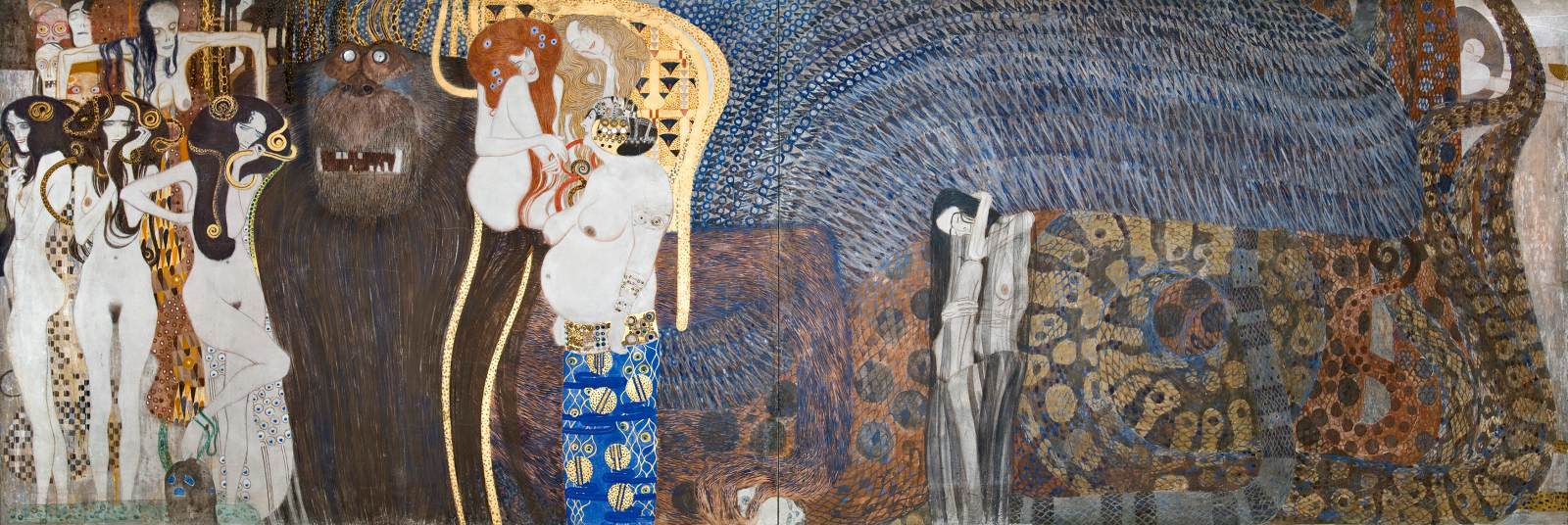
Austrian painter and graphic artist. He was just 14 when he won a scholarship to the Kunstgewerbeschule in Vienna. Together with his brother Ernst Klimt (1864-1892) and his fellow student Franz Matsch (1861-1942), between 1882 and 1892, he carried out a number of major commissions for wall and ceiling paintings. During this period, he was awarded the Golden Order of Merit and the Imperial prize. In 1897, he was a joint founder of the journal Ver Sacrum and the Vienna Secession, which he left in 1905 with a number of his friends, including Josef Hoffmann and Otto Wagner, in order to found the Wiener Werksttte. In 1917, he became an honorary member of the Vienna and Munich academies. Klimt ranks amongst the leading representatives of Viennese Jugendstil. While his early paintings still betrayed the influence of Hans Makart, after the death of his brother, he moved away from academic painting and developed his own two-dimensional style, in which representational elements are combined with ornament to achieve a decorative effect. Although his style caused several scandals in his own day (e.g. his ceiling paintings for Vienna University, 1900-03), it also made him a pioneer of modernism. His major works include the Beethoven frieze (1902), Judith (1901), the Kiss (1908) and his wall mosaics for the Palais Stoclet in Brussels (1909-11). As a leading exponent of Art Nouveau, Klimt is considered one of the greatest decorative painters of the 20th century. His depictions of the femme fatale and his drawings treating the theme of female sexuality have assured him a place in the history of erotic art. He is remembered for his role in the formation of the Vienna Secession, the radical group of Austrian artists of which he became the first president in 1897, and also for the frequent scandals and protests that marked his later career.
View all works →