Sir Godfrey Kneller
1646 – 1723
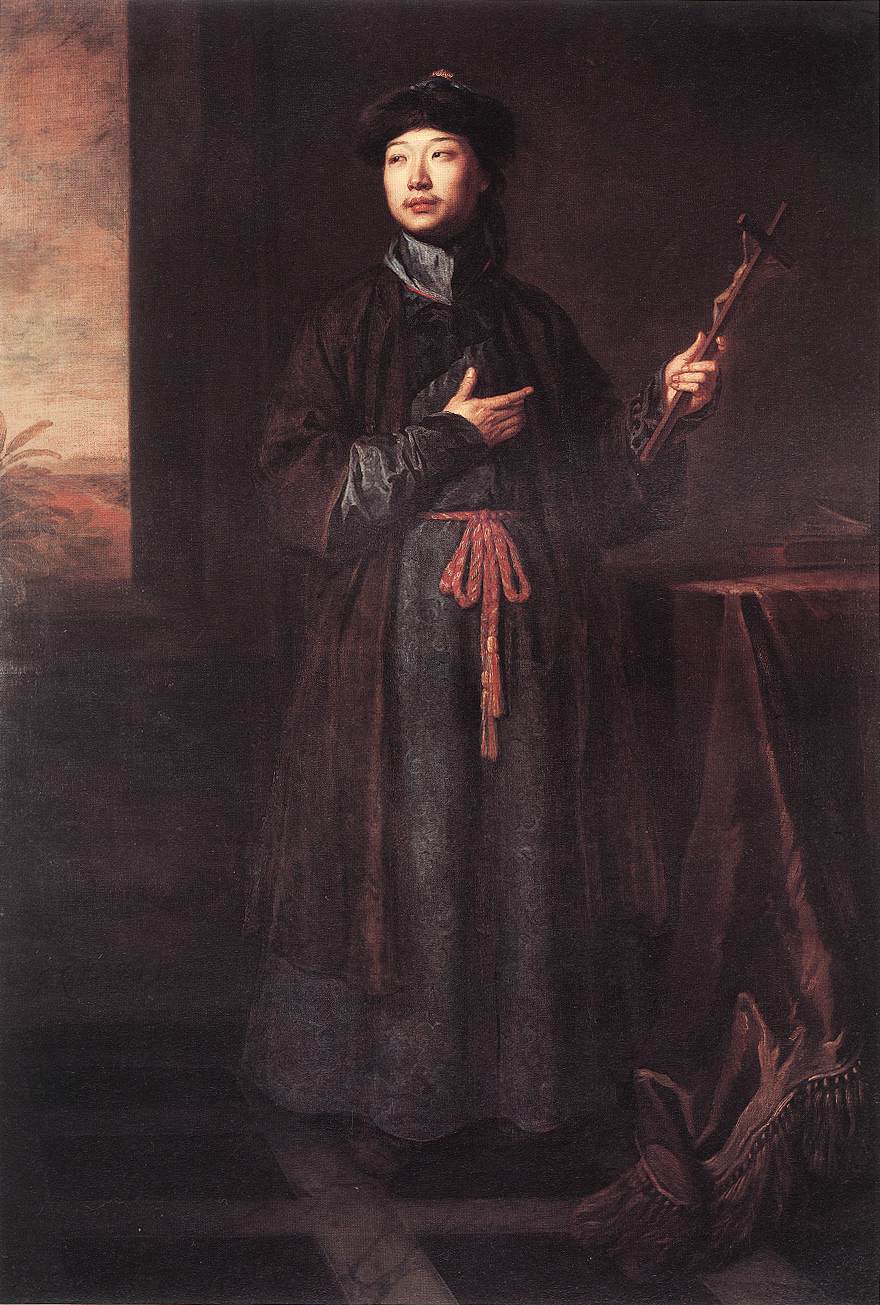
German-born painter (originally Gottfried Kniller) who settled in England and became the leading portraitist there in the late 17th century and early 18th century. He studied in Amsterdam under Bol, a pupil of Rembrandt, and later in Italy, before moving to England, probably in the mid 1670s. The opportune death of serious rivals (notably Lely in 1680) and his own arrogant self-assurance enabled him to establish himself as the dominant court and society painter by the beginning of the reign of James II (1685). He was appointed Principal Painter jointly with Riley on the accession of William III and Mary II in 1689 (becoming sole bearer of the title when Riley died in 1691), was knighted in 1692, and created a baronet in 1715. Kneller established a workshop-studio in London with a large team of specialized assistants, many of them foreign, organized for the mass-production of fashionable portraits. Sitters were required to pose only for a drawing of the face and efficient formulas were worked out for the accessories. He is said sometimes to have accommodated as many as fourteen sitters in a day. The average portrait turned out from this studio in this way was slick and mechanical (the heavy wigs then fashionable make for great monotony in male portraits), but Kneller was capable of work of much higher quality when he had a sitter to whom he especially responded; outstanding examples are The Chinese Convert (Kensington Palace, London, 1687) and Matthew Prior (Trinity College, Cambridge, 1700). Many other examples of his work, including the portraits of the Kit-Cat Club, are in the National Portrait Gallery, London. His style was less elegant and more forthright than Lely's, but the influence of his mass-produced work was stultifying. He was the last foreign-born artist to dominate English painting, but it needed a Hogarth and a Reynolds to break through the conventions that he had popularised.
View all works →