Franz Krüger
1797 – 1857
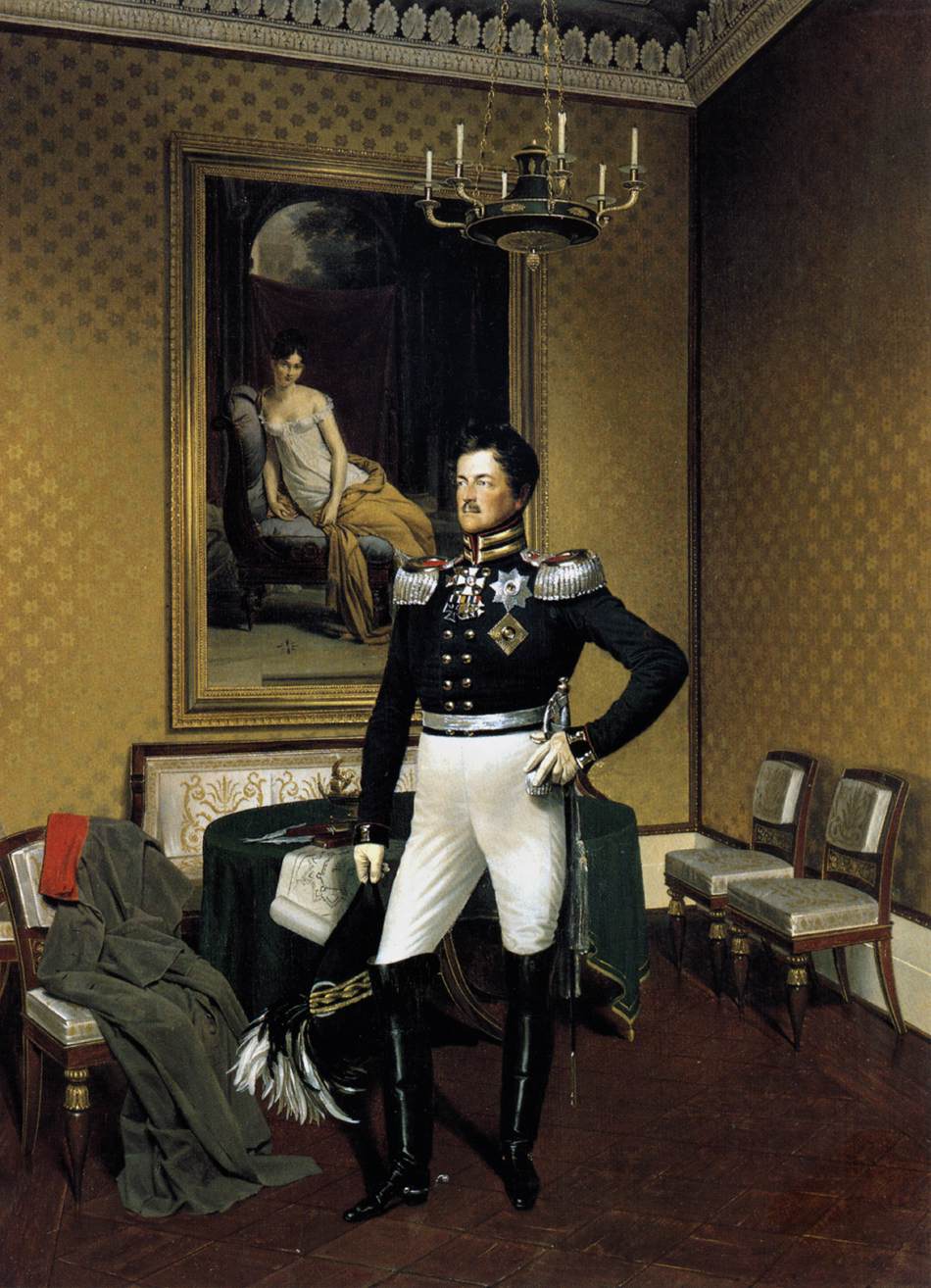
German painter. He first trained under the printmaker Carl Wilhelm Kolbe, who instilled in him the qualities of precise observation and solid workmanship. Krüger was accepted into the Berlin Akademie in 1812, but he also continued to train independently, carrying out studies of horses. He soon developed a gift for finding themes that appealed to Prussian society and that reflected it attractively but truthfully; thus he favoured hunting and stable scenes. The wars against Napoleon, however, inspired him to paint military subjects, and in 1818 he gained public recognition with such paintings as March of the Prussian Cavalry (1820; Doorn, Huis Doorn), which shows the return to Berlin of the Prussian troops under Field Marshal Gneisenau in 1815. Having painted a portrait of Prince August of Prussia (c. 1819; Doorn, Huis Doorn), Krüger gained access to the patronage of the court. In 1824 he executed half-length chalk portraits (lost) of the whole Prussian royal family, works that were typical of Berlin painting in their lack of pretension and their skilful presentation of character. In the representation of historical events Krüger revealed his ability to combine portraits and genre painting. The large Parade on the Opernplatz painted for Tsar Nicholas I of Russia (1830; Berlin, Neue Nationalgalerie) and the Prussian Parade for Friedrich Wilhelm III, King of Prussia (1839; Potsdam, Neues Palace), include a large number of individual portraits. In these pictures, Krüger shows the unity of royalty and the people. In the Homage to Frederick William IV (1841-43; Potsdam, Neues Palacce) Krüger painted a third picture of this type, containing an even greater number of figures. As a royalist, Krüger was profoundly dismayed at the political unrest of 1848, and his last large painting with a crowd scene, the Regimental Surrender in Potsdam (1849; Berlin, Neue Nationalgalerie), does not repeat the patriotic message of the earlier paintings.
View all works →