Georges de La Tour
1593 – 1652
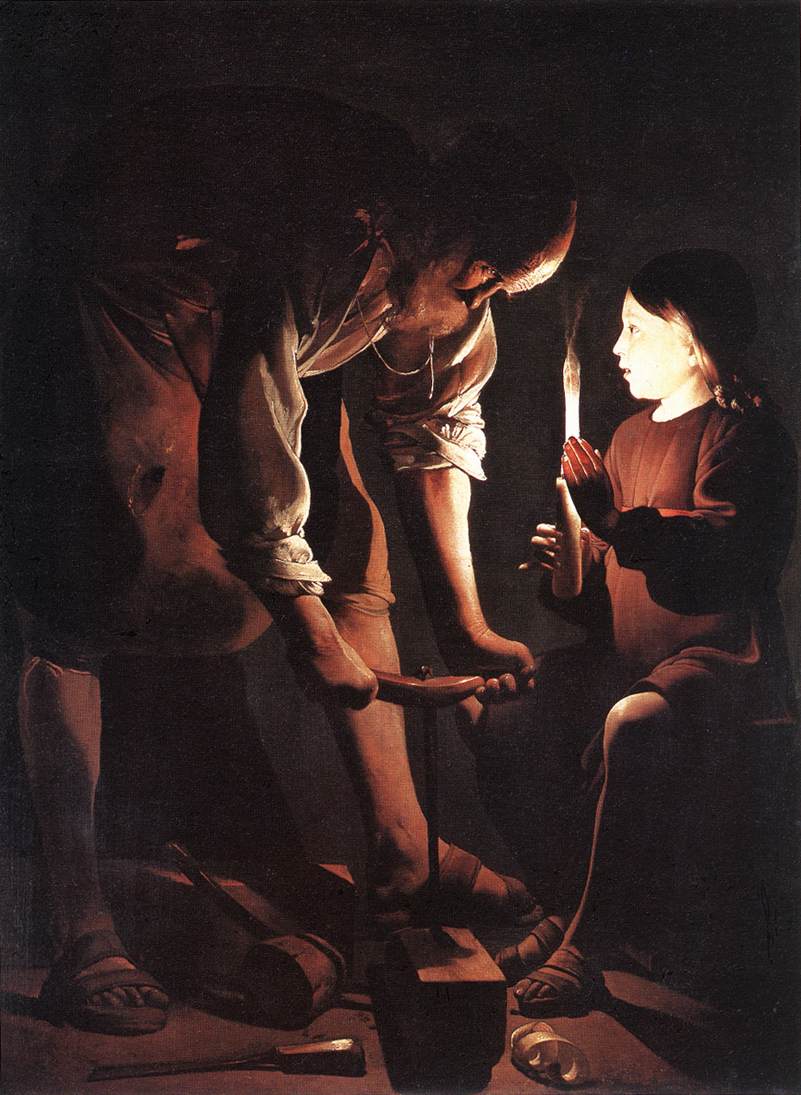
French painter, mostly of candlelit subjects, who was well known in his own time but then forgotten until well into the 20th century, when the identification of many formerly misattributed works established his modern reputation as a giant of French painting. The son of a baker, he is first documented as a painter in his native Vic at the time of his marriage contract in 1617. Three years later he moved to Lunéville, where he seems to have remained for the rest of his life. A few commissions and contracts for pictures are recorded, but none of them can with certainty associated with pictures known today. La Tour became a master painter. King Louis XIII, Henry II of Lorraine, and the Duke de La Ferté were among the collectors of his work. Although the chronology of La Tour's output is uncertain, it is clear that he initially painted in a realistic manner and was influenced by the dramatic chiaroscuro of Caravaggio or his followers. The paintings of La Tour's maturity, however, are marked by a startling geometric simplification of the human form and by the depiction of interior scenes lit only by the glare of candles or torches. His religious paintings done in this manner have a monumental simplicity and a stillness that expresses both contemplative quiet and wonder. The body of his work was conclusively identified by the German art historian Hermann Voss and by other scholars after 1915. La Tour's work also exhibits a high degree of originality in colour and composition; the characteristic simplification of forms gives many of his pictures a deceptively modern appearance. Among La Tour's most impressive candlelit scenes are The Newborn, St Joseph the Carpenter, and The Lamentation over St Sebastian. The Hurdy-gurdy Player and The Sharper are among his less numerous daylight compositions.
View all works →