Le Nain Brothers
1598 – 1648
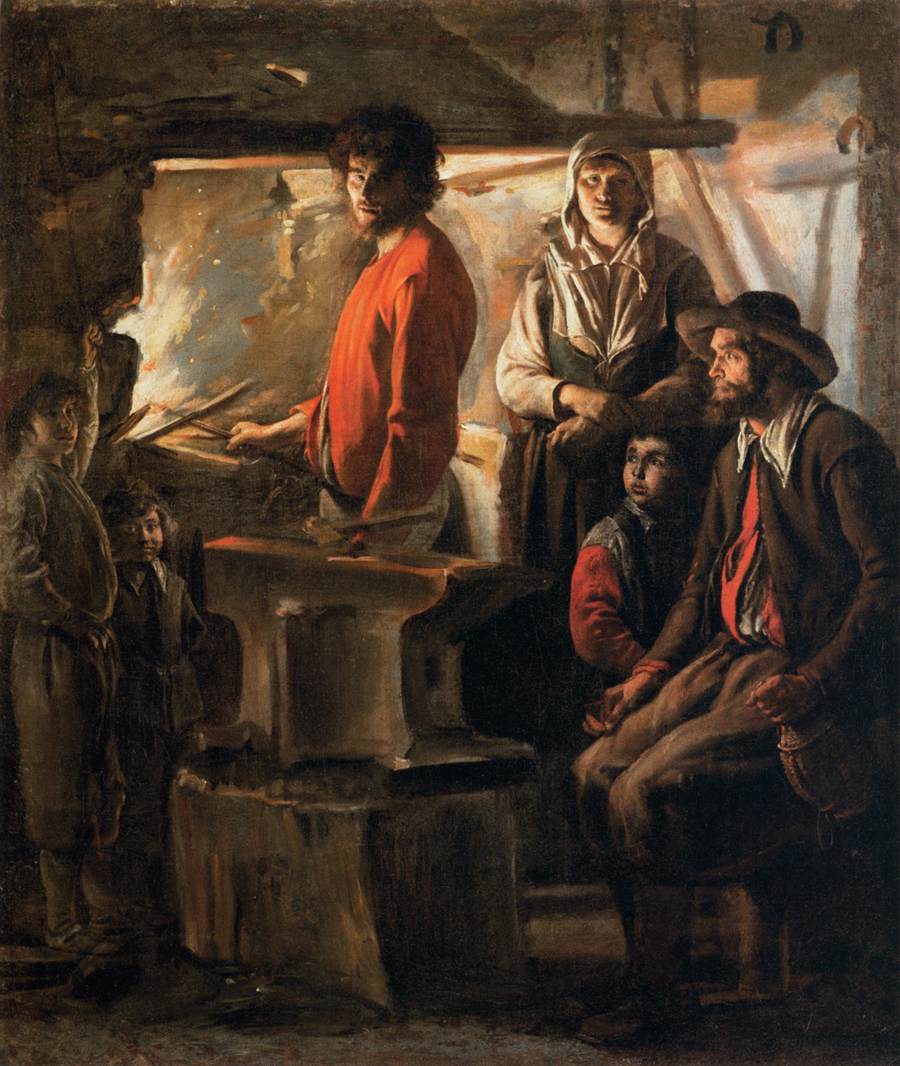
French painters, brothers (Antoine, d. 1648, Louis, d. 1648, Mathieu, c. 1607-1677), who were born at Laon but had all moved to Paris by 1630. The traditional birth-dates for Antoine and Louis are 1588 and 1593, respectively, but it is now thought that they were born shortly before and shortly after 1600, so that all three brothers were of much the same generation. Mathieu was made painter to the city of Paris in 1633, and all three were foundation members of the Academy in 1648. Apart from this, little is known of their careers and the assigning of works to one or the other of them is fraught with difficulty and controversy, for such paintings as are signed bear only their surname, and of those that are dated none is later than 1648, when all were still alive. The finest and most original works associated with the brothers - powerful and dignified genre scenes of peasants - are conventionally given to Louis; Antoine is credited with a group of small-scale and richly coloured family scenes, mainly on copper; and in a third group, attributed to Mathieu, are paintings of more eclectic style, chiefly portraits and group portraits in a manner suggesting influence from Holland. The brothers are also said to have collaborated on religious works. Examples of all three types are in the Louvre. In 1978-79 a major exhibition in Paris brought together most of the pictures associated with the brothers, but it raised as many problems as it solved. It also confirmed the stature of Louis, whose sympathetic and unaffected peasant scenes are the main reason why the Le Nains have attracted so much attention. It has recently been proposed that the traditional description of the figures in these paintings as 'peasants' is a misnomer (they are said to be too well dressed for that) and that in fact they represent members of the bourgeoisie.
View all works →