Bartolomeo Della Gatta
1448 – 1502
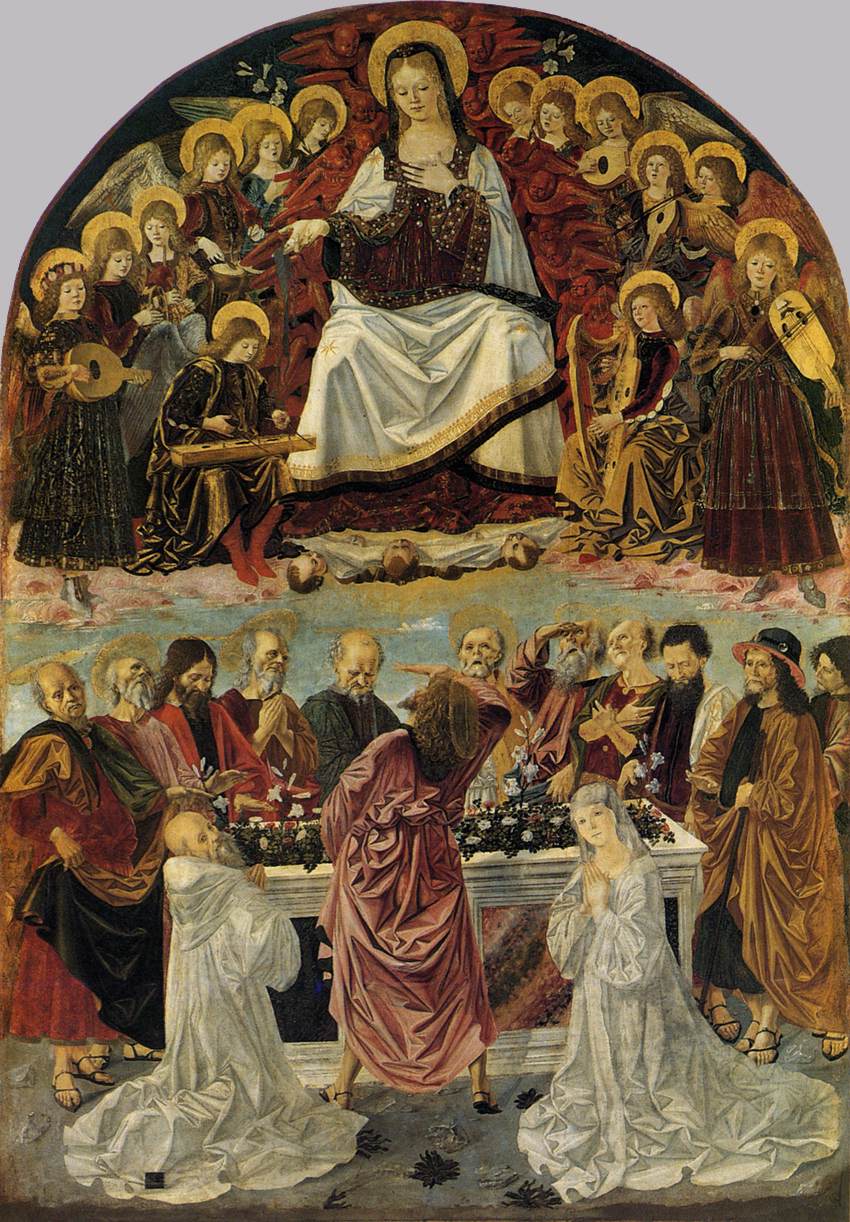
Italian painter, illuminator and architect (original name: Pietro di Antonio Dei). The son of a goldsmith, he was enrolled in the Florentine goldsmiths' guild at the age of five. Later he must have frequented the workshops of Antonio and Piero Pollaiuolo and, particularly, that of Andrea Verrocchio, where the major artists of his generation, such as Botticelli, Ghirlandaio, Leonardo da Vinci, Lorenzo di Credi, Perugino and Signorelli, used to meet. He probably also had contacts with artists in Arezzo, especially Piero della Francesca, and in Urbino, where Melozzo da Forli, Donato Bramante, Justus of Ghent and Pedro Berruguete worked. Early links with Urbino are also suggested by his friendship, noted by Vasari, with Gentile de' Becchi of Urbino (later Bishop of Arezzo) and by a miniature of the Martyrdom of St Agatha, definitely by his hand, in gradual D of Urbino Cathedral (Cathedral archive). In 1468 he took holy orders, probably in the Camaldolese monastery of S Maria degli Angeli, Florence, which his brother Nicolo had already entered. In 1470 he was in Arezzo at the convent of S Maria in Gradi and had the adopted name of Bartolomeo ('della Gatta' apparently refers to his fondness for a female cat). He spent most of the rest of his life in Arezzo, where he became abbot of S Clemente. He was active in the eastern Tuscany, between Arezzo and Sansepolcro. In circa 1475 he depicted The Assumption in San Domenico in the city of Cortona. In 1482 Bartolomeo was in Rome, together with Luca Signorelli, depicting Cappella Sistina: he was assistant to Perugino and Luca Signorelli. Later he created the Madonna and Saints (1486) and the Stigmata of St Francis (1486/1487), both now in Pinacoteca di Castiglion Fiorentino. In his paintings Bartolomeo mixed different styles and tendencies, from the naturalism of the Florentine environment, in which he began his artistic life, to the vision of volume and light of Piero della Francesca and the young Perugino. He also achieved fame as a miniaturist.
View all works →