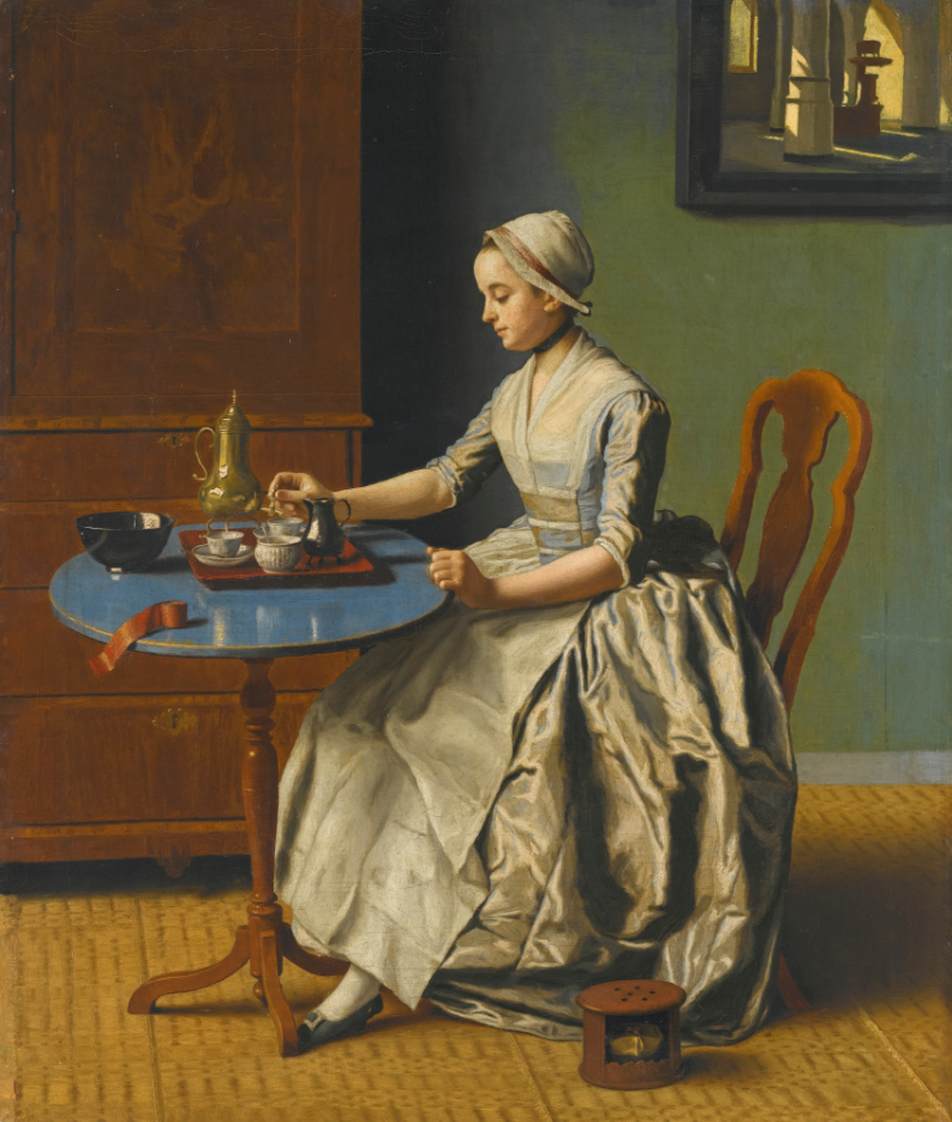
Étienne Liotard
1702 – 1789
Swiss pastellist, painter, printmaker and writer. He was born to French Protestant parents, who had fled to Switzerland after the Revocation of the Edict of Nantes. Having studied with the miniature painter Daniel Gardelle in Geneva, in 1723 he travelled to Paris, where until 1726 he was a pupil of Jean-Baptiste Massé. In 1734 he submitted his only known history painting, King David and the High Priest Abimelech in the Tabernacle (untraced), for the painting prize of the Académie Royale de Peinture et de Sculpture, but it was rejected. He subsequently travelled to Naples and then to Rome, where he executed a portrait of Pope Clement XII (untraced). In Florence he met Sir William Ponsonby (1704-93), later 2nd Earl of Bessborough, whom he accompanied to the Levant in 1738, breaking the journey in Capri, Messina, Syracuse, Malta and the Greek islands; there, seduced by the beauty of Eastern dress, he made a large number of acute and charming drawings in black and red chalks (Paris, Louvre; Paris, Bibliothèque Nationale). He spent 4 years in Constantinople (1738-42), after which he adopted Turkish dress and beard, his eccentric appearance being familiar from his numerous self-portraits. Finally he settled at Geneva in 1758, though still travelling elsewhere until late in life. Though he executed some oil paintings, he specialized in pastel portraits. He was probably influenced by the success in Paris in 1720-21 of the Venetian pastellist Rosalba Carriera. His delicate and polished style brought him fashionable success in Paris, and England, which he twice visited (1733-35 and 1772-74). The best collection of his work is in the Musée d'Art et d'Histoire in Geneva, his native city.
View all works →