FINDART

Coronation of the Virgin and Adoring Saints

1407 · National Gallery, London

religious

Piero di Giovanni became 'Lorenzo Monaco' (Lorenzo the Monk) upon taking his vows in 1391 at the Camaldolese monastery of Santa Maria degli Angeli, Florence. This ascetic order had been founded in 1012 by a Benedictine monk, Saint Romuald, shocked at the decadent laxity of his own monastery, and named by him after the mountain locality of Camaldoli in Tuscany where he built a hermitage. Legend has it that he dreamed of a ladder stretching from earth to Heaven, on which men in white robes were ascending, and thereupon decreed that the monks of his new order would dress in white.

Loading map…
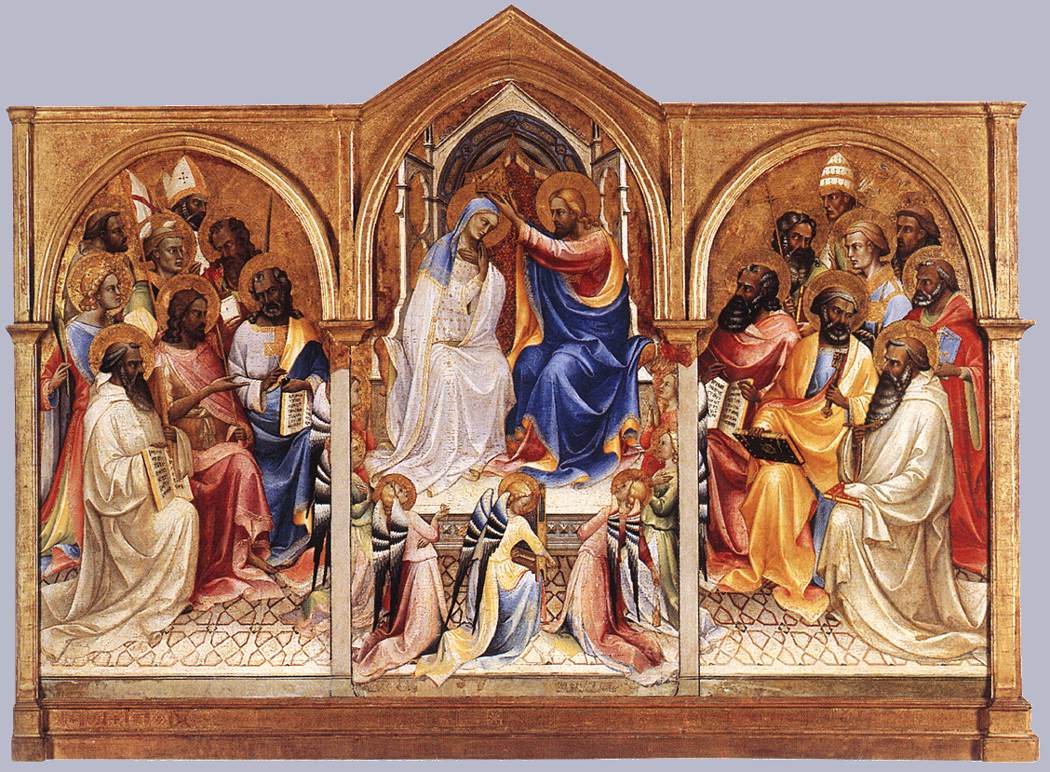
Coronation of the Virgin and Adoring Saints

About the Artist

Lorenzo Monaco

13701425

Italian painter who was probably born in Siena, but seems to have spent all his professional life in Florence. In 1391 he took his vows as a monk of the Camaldolese monastery of Sta Maria degli Angeli. He rose to the rank of deacon, but in 1402 he was enrolled in the painters' guild under his lay name, Piero di Giovanni (Lorenzo Monaco means 'Laurence the Monk'), and was living outside the monastery. The monastery was renowned for its manuscript illuminations and several miniatures in books in the Laurentian Library in Florence have been attributed to him, but he was primarily a painter of altarpieces, good examples of which are in the National Gallery in London and the Uffizi in Florence. His main works in fresco are the scenes of the Life of Mary in the Bartolini Chapel of Sta Trinità, Florence. His style is distinguished by luminous beauty of colouring and a graceful, rhythmic flow of line. He stands in complete contrast to his great contemporary Masaccio and represents the highest achievement of the last flowering of Gothic art in Florence. Lorenzo Monaco was an artist whose work bridged the 14th and 15th centuries, between the Trecento art of Duccio and Giotto and the Quattrocento painting of Masaccio and Fra Angelico - upon whom Monaco was an important influence. His art was a synthesis of the Sienese and Florentine Trecento styles and was also one of the most important examples of International Gothic in Italy.

View all works →