Pierre-Antoine de Machy
1723 – 1807
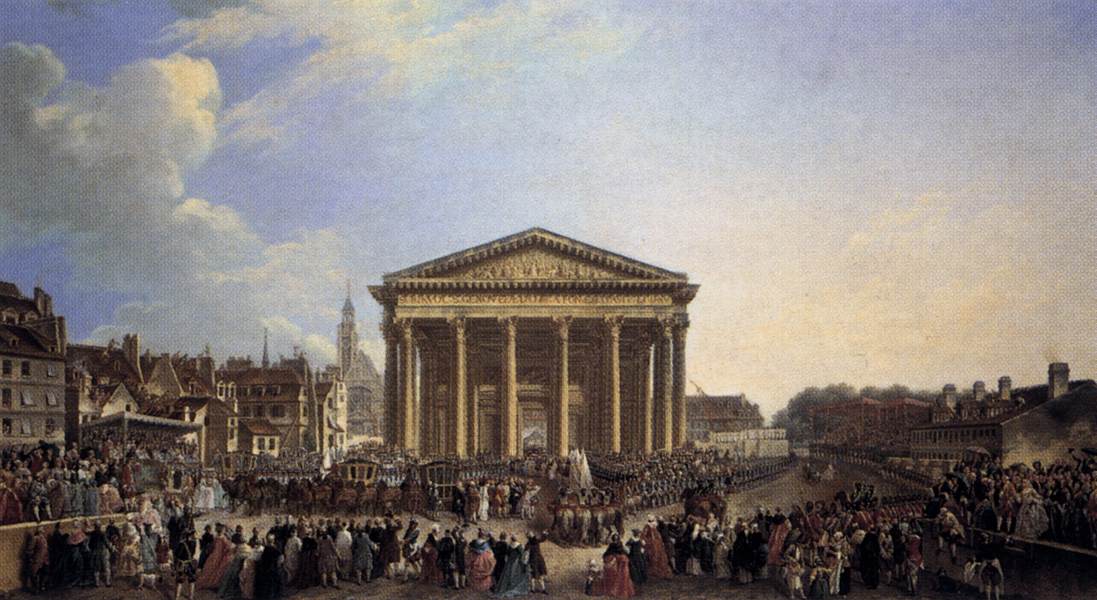
French painter and engraver. He was the son of a cabinetmaker and served his apprenticeship with Giovanni Niccolò Servandoni. He was approved (agréé) by the Académie Royale de Peinture, Paris, in 1755 and was received (reçu) three years later as a painter of architecture. He exhibited regularly at the Salon from 1757 to 1802. His views of the interiors of the Paris churches of Ste Geneviève and the Madeleine were painted from architectural plans and exhibited at the Salons of 1761 and 1763 respectively, earning Diderot's praise. At the Salon of 1763 de Machy also demonstrated his talent for painting contemporary events with a pair of pictures of the Foire Saint-Germain after the fire of 1762 (both Paris, Carnavalet) and a scene of the Installation of Bouchardon's Statue of Louis XV (untraced), with the statue being placed on its pedestal in the Place Louis XV (now the Place de la Concorde). Later, however, de Machy suffered increasingly from comparison with other painters, especially those who, unlike himself, had studied in Italy. At the Salon of 1765 his Inauguration of Ste Geneviève and the Building of the Halle au Blé (both Paris, Carnavalet) were overshadowed by Servandoni's works, and in 1767 his pictures were totally eclipsed by the works of Hubert Robert, who had recently returned from Italy. At this exhibition Diderot found de Machy's pictures lacking in the quality of handling and Italian light effects that characterized Robert's painting.
View all works →