Alessandro Magnasco
1667 – 1749
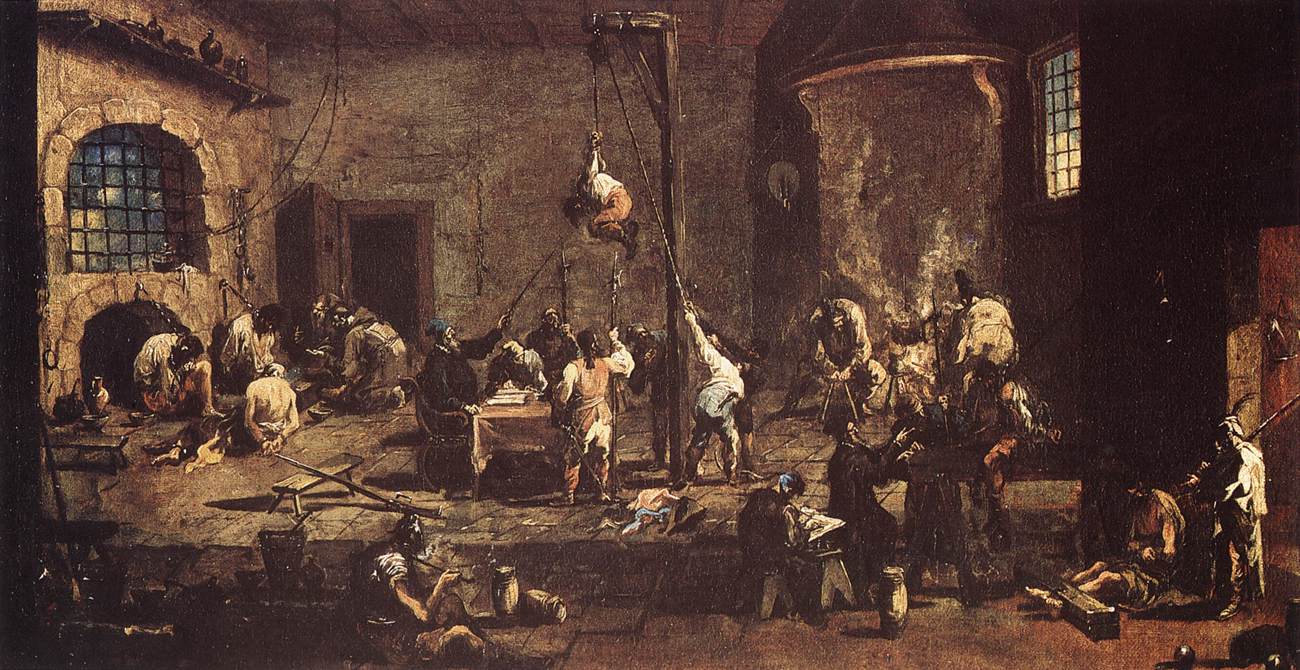
Italian painter, called Il Lissandrino. He was born and died in Genoa, but spent most of his working life in Milan. Son of a minor Genoese painter, Alessandro Magnasco trained in his home town before moving to Milan when he was still young. There he worked for many years in Filippo Abbiati's studio. His meeting with Sebastiano Ricci marked a turning-point in his art. Their acquaintance was renewed during a stay in Florence (1703-09) at the court of Grand Duke Ferdinand of Tuscany. Soon afterwards, Magnasco gave up painting large figures (he only produced a handful of these in his later years) and instead concentrated on his unmistakable canvases with fantastic landscapes or interiors peopled with weird characters. At the start he stuck to windswept countryside and ruins with beggars. But during his second and longer stay in Milan (1709-35), he turned to the type of work for which he is now known - highly individual melodramatic scenes set in storm-tossed landscapes, ruins, convents, and gloomy monasteries, peopled with small elongated figures of monks, nuns, gypsies, mercenaries, witches, beggars, and inquisitors. His brushwork is nervous and flickering and his lighting effects macabre. His output was extremely well received in Milanese scholarly circles. He was very prolific and his work is rarely dated or datable. The critical jury is still out as to any deeper meaning of these canvases, which mingle the macabre with the burlesque, simple description with powerful melodrama. Magnasco went back to Genoa in old age and it is there that we find his last, visionary and transfigured works. His art later influenced Marco Ricci and Francesco Guardi.
View all works →