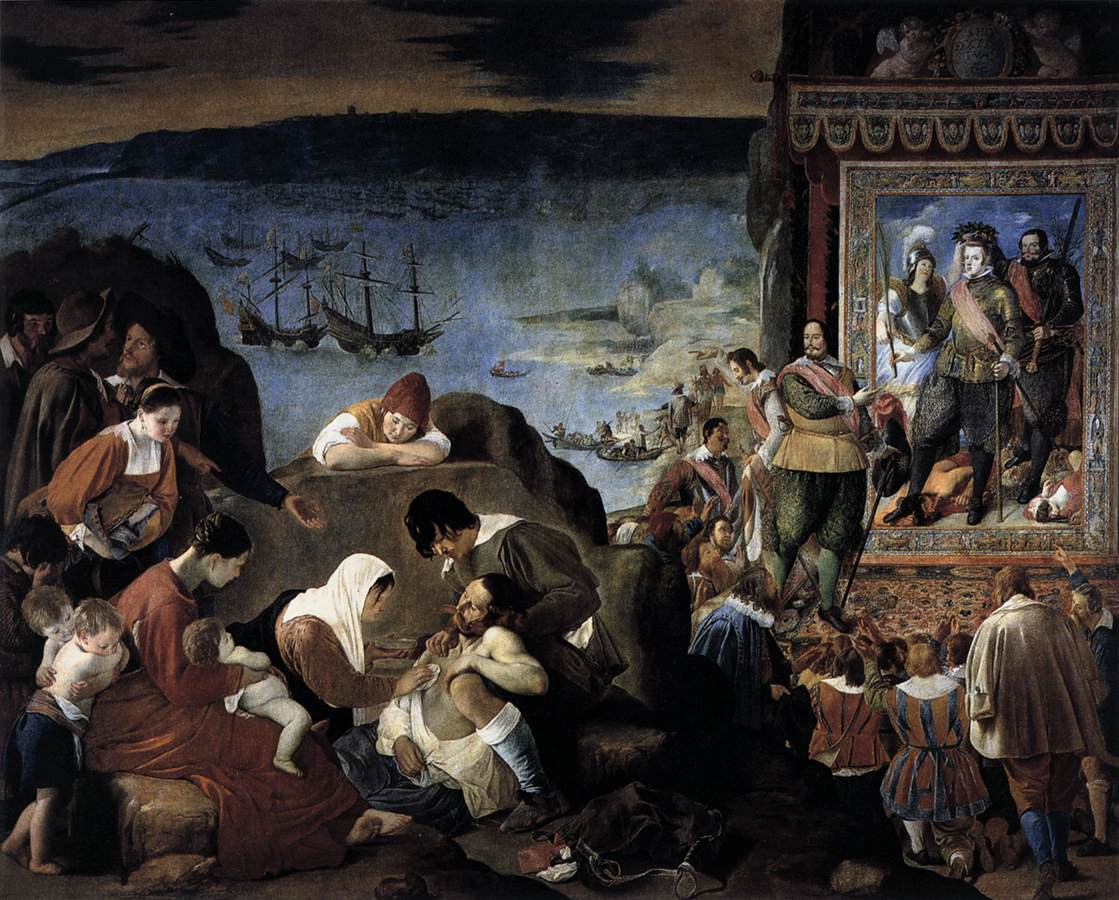
Fray Juan Bautista Maino
1581 – 1649
Juan Bautista Maino (or Mayno), Spanish painter. He was born in Pastrana (Guadalajara), the son of a Milanese father and Portuguese mother, who was in the service of the princess of Eboli. There is a tradition that he was a pupil of El Greco in Toledo, but there is no suggestion of this in Maino's clear and firm style, which was formed in Italy c. 1600-10. Knowledge of Maino's stay in Italy is based on the brief mention of a seventeenth-century writer, who refers to him as a disciple of Annibale Carracci and friend of Guido Reni, which, if accurate, would date his Roman sojourn to the first five or six years of the century. Around 1608 or 1609, Maino had returned to his native town, where he painted a Trinity for a lateral altar in the church of the Franciscanas Concepcionistas, a work that lends credibility to his putative friendship with Guido Reni. By March 1611, Maino had moved to Toledo and was working for the cathedral, restoring a fresco in the cloister. A commission for an original work - now unfortunately lost - soon followed. A year later, Maino was hired by the Dominican monastery of San Pedro Martir to paint the main altarpiece of the church and the frescoes inside the entrance portal, under the choir. The altarpiece decoration consists of four large paintings - the Adoration of the Shepherds (Madrid, Prado), the Adoration of the Magi (Madrid, Prado), the Resurrection (Villanueva y Geltru, Museo Balaguer), and the Pentecost (Madrid, Prado) - and four small landscapes with saints, together with half-length portraits of St Catherine of Siena and St Dominic (perhaps a self-portrait). Maino's artistic career virtually came to an end on 20 June 1613, when he professed as a Dominican in the very monastery of San Pedro Martir. A few years later, he moved to Madrid and was appointed the drawing master of Prince Philip, the future Philip IV. Maino seldom picked up his brushes from 1613 to the day he died in March 1641, although, when he did (Dominican Monk, c. 1635, Ashmolean Museum, Oxford), his brilliance was undiminished.
View all works →