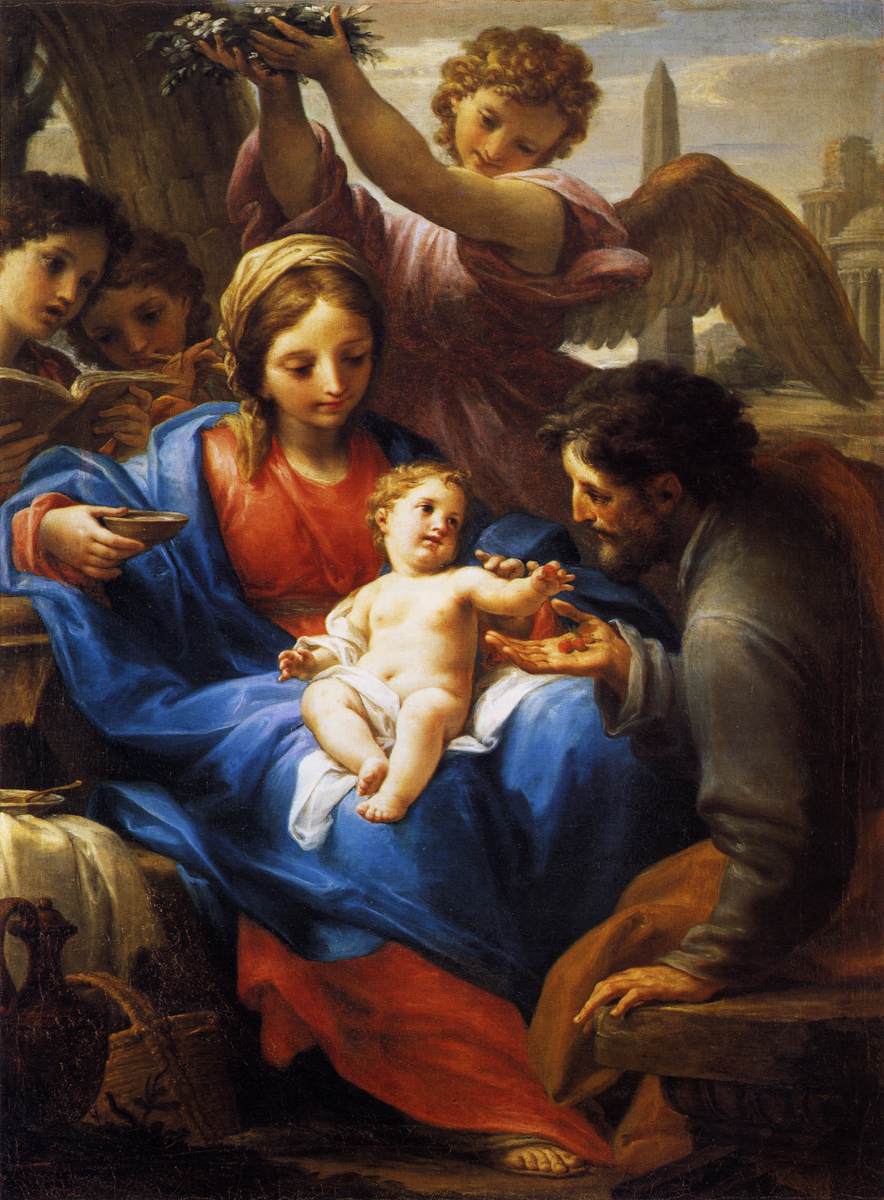
Francesco Mancini
1679 – 1758
Italian painter. He was trained in Bologna in the school of Carlo Cignani, and his art is rooted in the classicist tradition of Bologna and Emilia Romagna. His achievements can be measured not only by his official appointments (French Academician, 1732; associate and regent of the Congregazione dei Virtuosi al Pantheon, 1743, 1745; principal of the Accademia di S Luca, 1750-51) but also by the numerous commissions, almost exclusively ecclesiastical, that he obtained both in Rome and in the provinces. These made a significant contribution to the development of the form and iconography of the altarpiece. Mancini holds a remarkable position in the circle of artists working in the Papal States during the first half of the eighteenth century. In 1714 he was summoned to work in Ravenna (in the library known as the Biblioteca di Classe), later in 1719 to the cathedral of Foligno, and in 1725 he moved to Rome. On his arrival in the papal city he was elected a member of the Academy of Saint Luke and executed several works including the Miracle of Saint Peter and Saint John in the Quirinal Palace and The Healing of Tabitha commissioned for St. Peter's Basilica by Pope Benedict XIII (1724-50). Knowledge of Mancini's profane works is rather more limited, and the best of these is the cycle of frescoes with the Stories of Psyche in the coffeehouse of the Palazzo Colonna (1735-40). The frescoes of the dome of the Chiesa Nuova dei Filippini in Perugia (1750), those of Our Lady of Mercy in Macerata (1756), and many other paintings bear evidence of his extensive activity in many churches in cities then belonging to the Papal States (Perugia, Citta di Castello, Fano, Forii, Rimini). He studied the great models of Emilian seventeenth-century painting but went back still further, fascinated by Correggio 's mannerism. During the period he spent in Rome he was influenced by the works of Gaulli and Pietro da Cortona. The various experiences the artist absorbed resulted in painting that was far from academic, characterized rather by a compositional ease and agility of execution that create a vital synthesis of baroque and rococo motifs, enriched by recollections of the sixteenth century.
View all works →