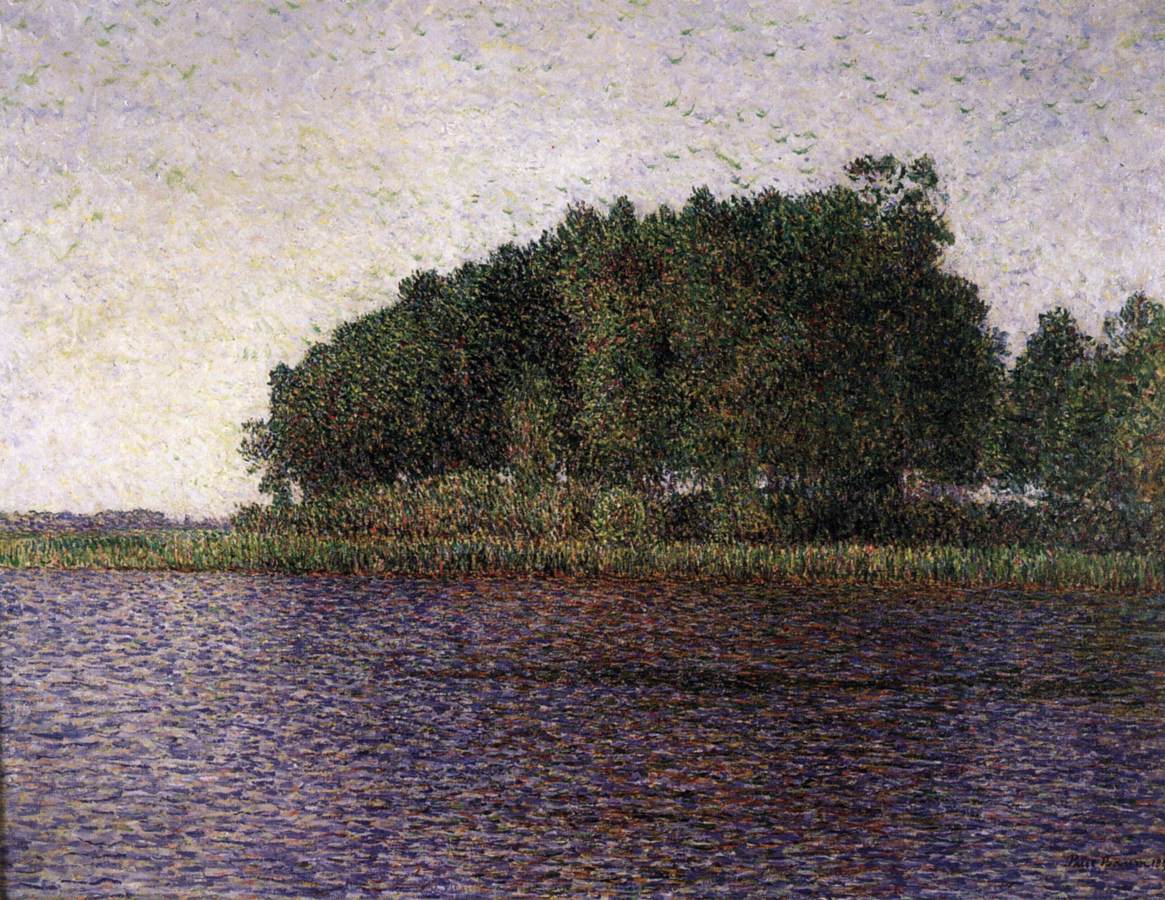
Paul Baum
1859 – 1932
German painter and printmaker, almost exclusively of landscapes. He spent his youth in Meien, where he began an apprenticeship as a flower painter at the porcelain manufacture at the age of 17. He studied at the Academy in Dresden, then in the atelier of the landscape painter Friedrich Preller the Younger (1838-1901), and then under Theodor Hagen (1842-1919) in the Weimar School of Art. Baum exhibited from 1880. During a trip to Paris in March 1890 Baum saw works by the Impressionists Monet, Pissarro and Sisley. In the same year he settled in Knocke-sur-Mer, the summer camp of the Impressionists. He lived here for four years after which he returned to Dresden as a member of the "Dresdener Sezession". Baum moved to the tiny village St. Anna ter Muiden near Sluis close to the Belgian-Dutch border in 1895. He continued living here, with several interruptions - various travels through Europe and lengthy sojourns in Berlin -, until 1914. After the beginning of the war Baum he moved to Dresden where he was appointed professor at the Akademie. From 1918 he taught landscape painting at the Kunstakademie in Kassel. From 1924 he spent most of his time in San Gimignano where he died from pneumonia in 1932. While Baum's early works are influenced by the plein-air painting of the School of Barbizon, his work after 1890, with its lighter palette and the use of comma-like brushstrokes, is more associated with the French Impressionists. In 1900 Paul Baum developed his own version of Neo-Impressionism and became one of the most important artists of this style in Germany.
View all works →