François-Guillaume Ménageot
1744 – 1816
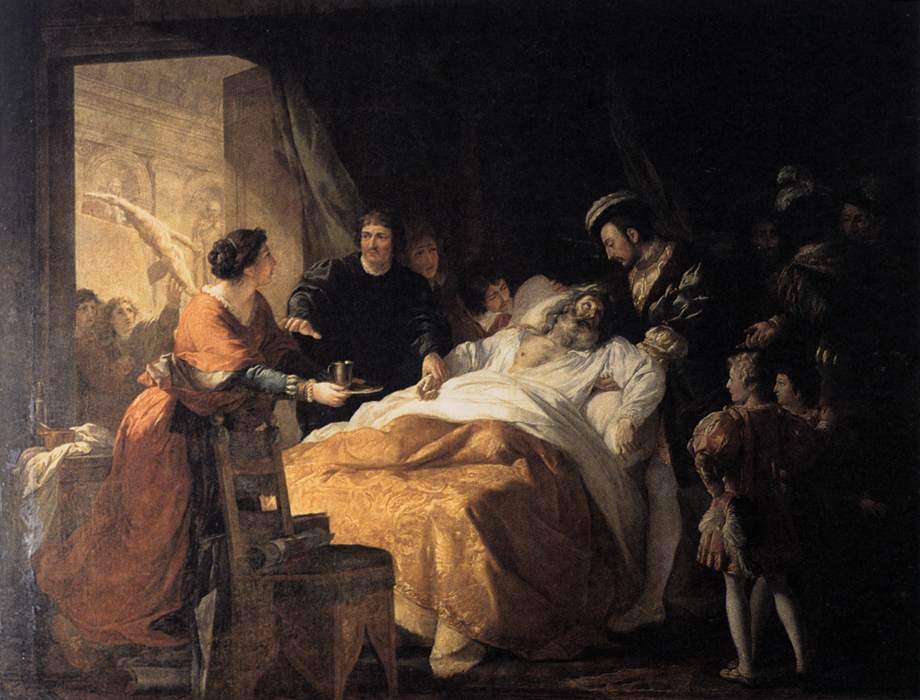
French painter. He was the son of Augustin Ménageot (d 1784), an art dealer and adviser to Denis Diderot, and he studied with Jean-Baptiste-Henri Deshays and with François Boucher, whose bravura style and use of light, warm colours he adopted in his early works. He won the Prix de Rome in 1766 with Tomyris Plunging the Head of Cyrus into a Bowl of Blood (Paris, Ecole Normale Supérieure des Beaux-Arts). From 1769 to 1774 he was at the Académie de France in Rome. Having been approved (agréé) as a history painter by the Académie Royale in Paris in 1777, he exhibited at the Salon the Farewells of Polyxena to Hecuba (Chartres, Musée des Beaux-Arts), a vast already Neoclassical work that was warmly received. His morceau de réception was a powerfully classicizing work entitled Learning Resisting the Passage of Time (1780; Paris, Ecole Normale Supérieure des Beaux-Arts). A year later he triumphed at the Salon with the Death of Leonardo da Vinci in the Arms of Francis I (Amboise, Hôtel de Ville). Ménageot was one of the painters who was involved in the return to the Grand Style: his compositions became more horizontal, the architecture more monumental, the drapery sculptural and the colouring increasingly cold. Works that bear witness to this development include Astyanax Torn from the Arms of Andromache (1783), Cleopatra Paying her Last Respects to Anthony (1785; both Angers, Musée des Beaux-Arts), the Continence of Scipio (1787; Zidlochovice Museum) and Meleager Implored by his Family (1789; Paris, Louvre), the last being one of his most resolutely Neoclassical works.
View all works →