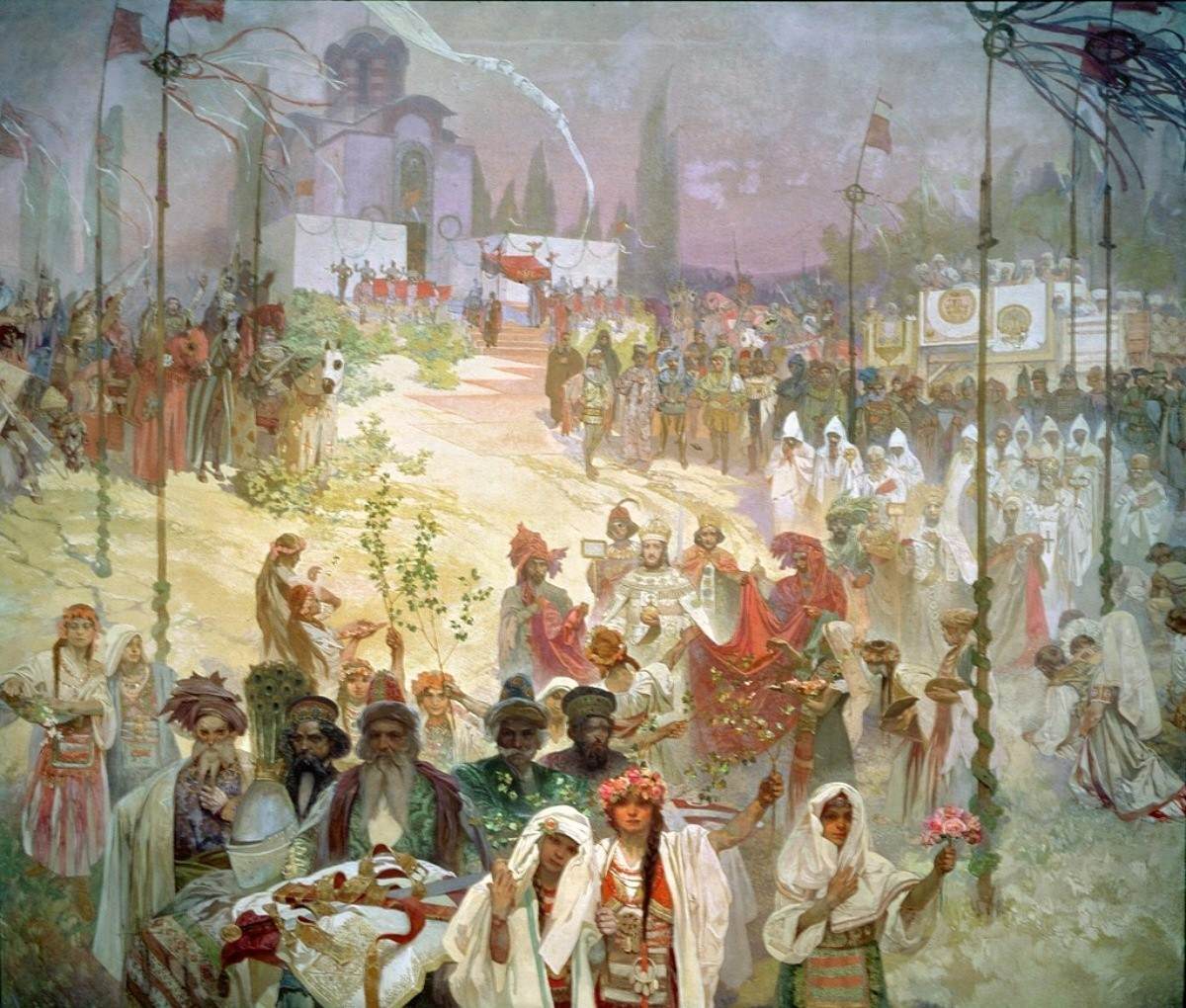
Alphonse Mucha
1860 – 1939
Czech graphic artist and painter, active in France. In 1877 he attempted unsuccessfully to enter the Academy of Fine Arts, Prague, and afterwards set about travelling and working. He went first to Vienna, where he worked for a company that produced stage sets. He left in 1882 for Mikulov, where he earned living painting portraits of important local figures. He went to the Akademie der Bildenden Knste in Munich (1885-87) and Paris in autumn 1888, where he enrolled at the Acadmie Julian and worked in the studios of Jules Lefebvre and Jean-Paul Laurens. When his grant was cut off at the end of 1889, he stayed in Paris and briefly attended the Acadmie Colarossi. To finance himself, he produced a variety of illustrations, collaborating on La Vie Populaire and the children's review Le Petit Franais illustr. Mucha exhibited at the Salon des Artistes Franais in 1894 and won a medal of honour. In the same year, he began teaching at the Acadmie Colarossi, and he designed the poster Gismonda for a production at the Thtre de la Renaissance, Paris. Mucha had already designed three posters, for soap, toothpaste, and stationery, but the Gismonda poster, intended for Sarah Bernhardt who was playing the title role and was also theatre manager, ratified him, taking him out of the more anonymous world of illustrators and into that of the great poster designers. Seduced by this new image of herself, Bernhardt signed a six-year contract with Mucha; he made six other large theatre posters for her, as well as undertaking designs for sets, costumes, and jewellery. Having established himself, he received many commissions. While working for Bernhardt, he made posters for commercial firms, including those for Job (1898) and Mot et Chandon (1899); he also designed a large number of stamps, vignettes, calendars, illustrations, and 'decorative panels', a lithographic type developed for Mucha (e.g. Times of the Day, colour lithographs, 1899). Mucha shared with his peers the desire to make art popular and acceptable. In this spirit, he co-founded, with Eugne-Samuel Grasset, Ren Lalique, Émile Gall , and Victor Horta, the Socit Internationale de l'Art Populaire, and with James McNeill Whistler he founded the Acadmie Carmen in 1898 (closed 1901). The influence of Hans Makart, Eugne-Samuel Grasset, and the Pre-Raphaelites contributed to Mucha's style, characterized by a sense of ornamentation, a balancing of realist and stylized elements, and a certain horror vacui. His taste for Byzantine art can be seen in the mosaic backgrounds and the portrayal of gorgeous garments laden with gold and precious gems. All these elements, used to enhance femininity, created a style that was perceived as typically Art Nouveau, despite Mucha's assertion that 'art is eternal, it cannot be new', and his rejection of any direct links with the movement. Fifty-eight posters by Mucha were printed in Paris, usually by the firm Champenois. In his commissions, Mucha gave free rein to his taste for female figures in theatrical poses, flamboyant curving lines, floral motifs, and delicate interwoven designs. He had two exhibitions in 1897, including Alphonse Mucha et son oeuvre (Paris, Salon des Cent), organized by La Plume. After his success as a poster artist, Mucha began to develop his talents as a designer. By 1900 his design work had expanded to a wide range of objects, including everyday domestic utensils, fixtures and sculptures, as well as packaging and interior decoration. He worked regularly with the Parisian jeweller Georges Fouquet, not only designing jewellery but also creating a comprehensive design scheme for his new boutique on the Rue Royale (1901). Mucha believed in the production of beautiful yet practical and affordable objects for ordinary people and published two design handbooks in the hope that designers would embrace this idea: Documents dcoratifs in 1902 and Figures dcoratives in 1905. The period 1895 to 1900 was Mucha's most prolific. His posters were of primary importance, but he continued to illustrate numerous books and published several series of decorative panels. In addition, he made designs for wallpaper and furniture. In 1910 he returned to Bohemia. He started working on the Slav Epic (1913; Moravsk Krumlov Castle), a series of 20 paintings, which he gave to the town of Prague in 1928. He saw himself as inheriting the decorative traditions of his native country and was convinced of the need to use his art to express his devoted attachment to ideals and traditions. He continued painting until his death.
View all works →