FINDART

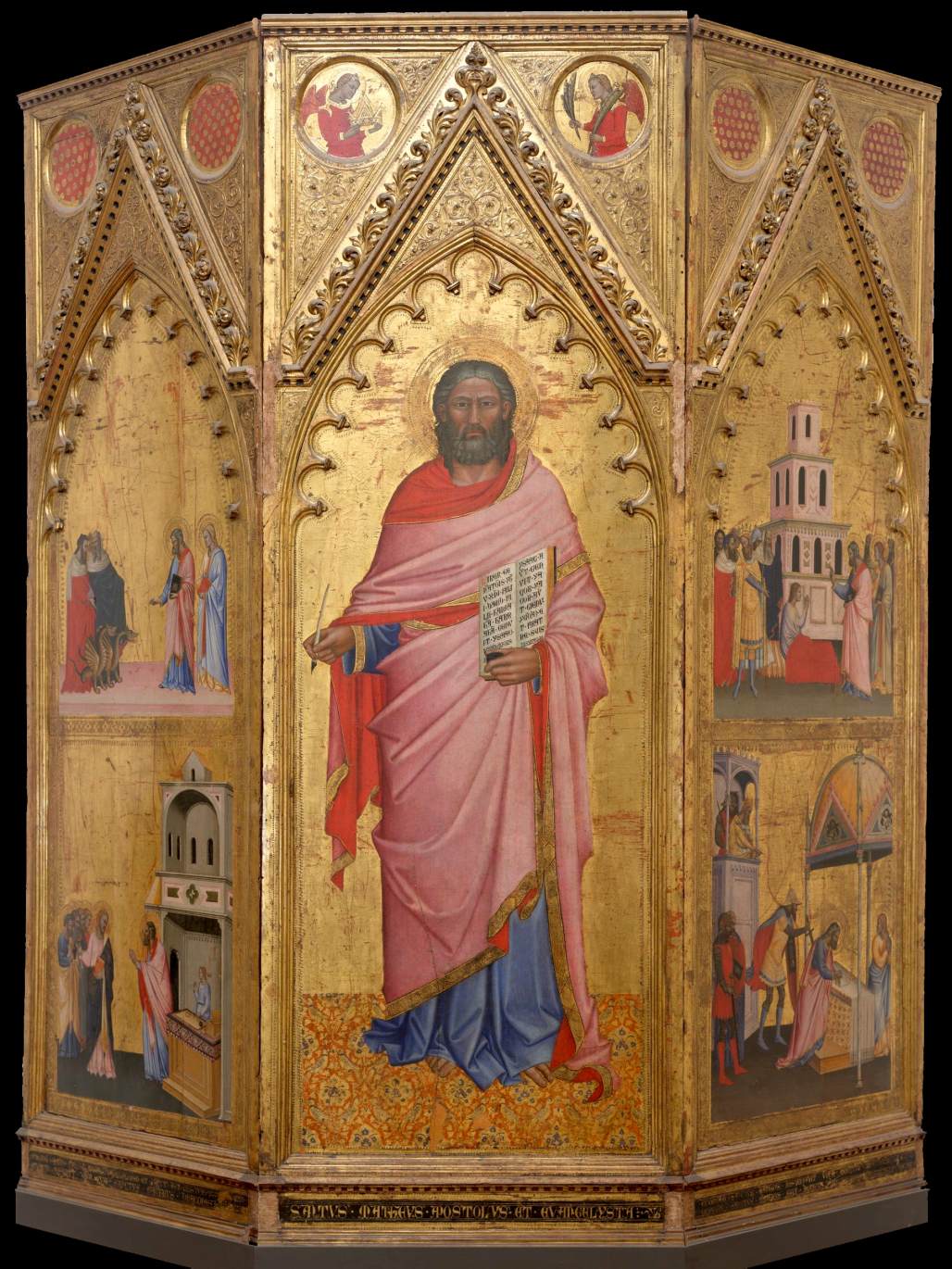
St Matthew and Scenes from his Life

1367 · Galleria degli Uffizi, Florence

religious

The unique form of this panel is due to the use for which it was originally intended: it was commissioned to adorn the pillar of the Church of Orsammichele in Florence, assigned to the Guild of Moneychangers. With its convex structure and three panels that, together, form a semi-hexagon, it was designed to embrace the pillar on three sides, telling the story of the life of Saint Matthew, patron saint of the Guild of Moneychangers. Matthew, apostle and evangelist, who, before Christ's calling, had been a tax collector and was known as Levi, due precisely to his original job of levying taxes, was and still is the protector of bankers, customs officers, financiers, money-changers, accountants, business consultants and tax collectors.
Loading map…
St Matthew and Scenes from his Life

About the Artist

Orcagna

13081368

Orcagna (real name Andrea di Cione), the leading Florentine artist of the third quarter of the 14th century, a painter, sculptor, architect, and administrator. His nickname 'Orcagna' was apparently local slang for 'Archangel' (Arcangelo). In 1343-44 he was admitted to the guild of the painters and nine years later to that of the masons. His only certain work as a painter is the altarpiece of The Redeemer with the Madonna and Saints (1354-57) in the Strozzi Chapel of Santa Maria Novella. This is the most powerful Florentine painting of its period, and in spite of the massiveness of the figures it represents a reversion from Giotto 's naturalism to the hieratic ideals of Byzantine art. Colours are resplendent, with lavish use of gold, and the figures are remote and immobile. The major work attributed to Orcagna is a fragmentary fresco trilogy of the Triumph of Death, Last Judgement, and Hell in Santa Croce. As a sculptor and architect he is known through one work, the tabernacle in Or San Michele (finished 1359), a highly elaborate ornamental structure housing a painting of the Virgin Enthroned by Bernardo Daddi. Orcagna was capomaestro of Orvieto Cathedral from 1358 to 1362, supervising the mosaic decoration of the façade. He was also an adviser on the construction of Florence Cathedral. During 1368 Orcagna fell mortally ill while painting the St Matthew altarpiece (Uffizi, Florence) and this work was finished by his brother Jacopo di Cione, who worked in his style and continued it to the end of the century. Another brother, Nardo di Cione , was also a painter. Ghiberti attributes to him the series of frescos of The Last Judgement, Hell, and Paradise in the Strozzi Chapel, Sta Maria Novella, which houses Orcagna's great altarpiece. Orcagna's style was the dominant influence in late 14th century Florentine painting.

View all works →