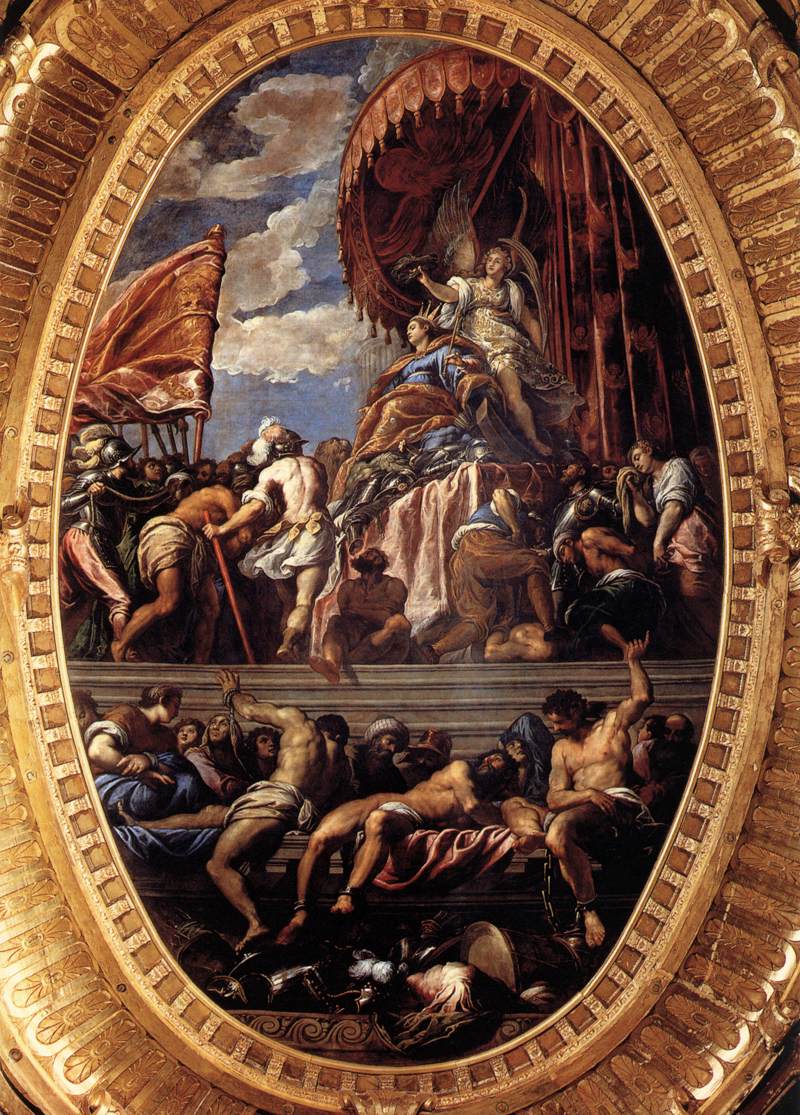
Palma Giovane
1548 – 1628
Palma Giovane (Jacopo di Antonio Negretti), Venetian painter, great-nephew of Palma Vecchio. He is said to have been a pupil of Titian, but this tradition has been doubted (it is probably based on the fact that he completed the Pietà which Titian left incomplete at his death). In the late 1560s and early 1570s he worked in central Italy, mainly Rome, but thereafter he spent the rest of his life in Venice, and after the death of Tintoretto in 1594 he was the leading painter in the city. He worked alongside Veronese and Tintoretto on the decorations in the Doge's Palace where he came to know fully the Venetian tradition. From 1580-90 he painted cycles of large canvases either for Venetian Schools or sacred buildings (the sacristies of San Giacomo dall'Orio and of the Jesuit church, the Scuola di San Giovanni Evangelista, and the Ospedaletto dei Crociferi ). Thanks to the intelligent way they quoted from Tintoretto and their own narrative drive, these are Palma the Younger's best works. After this he went back to official commissions at the Doge's Palace. He organized his own, large studio which he used to produce a repetitive series of religious and allegorical pictures that can be found throughout the territory of the Venetian Republic. His style was influenced by several of his great Venetian predecessors - Veronese as well as Titian and Tintoretto - and by central Italian Mannerism. He was extremely prolific, fulfilling many commissions from abroad as well as for Venetian churches, and his later work is often mechanical. As well as religions pictures, he painted historical and mythological works, and he also made etchings.
View all works →