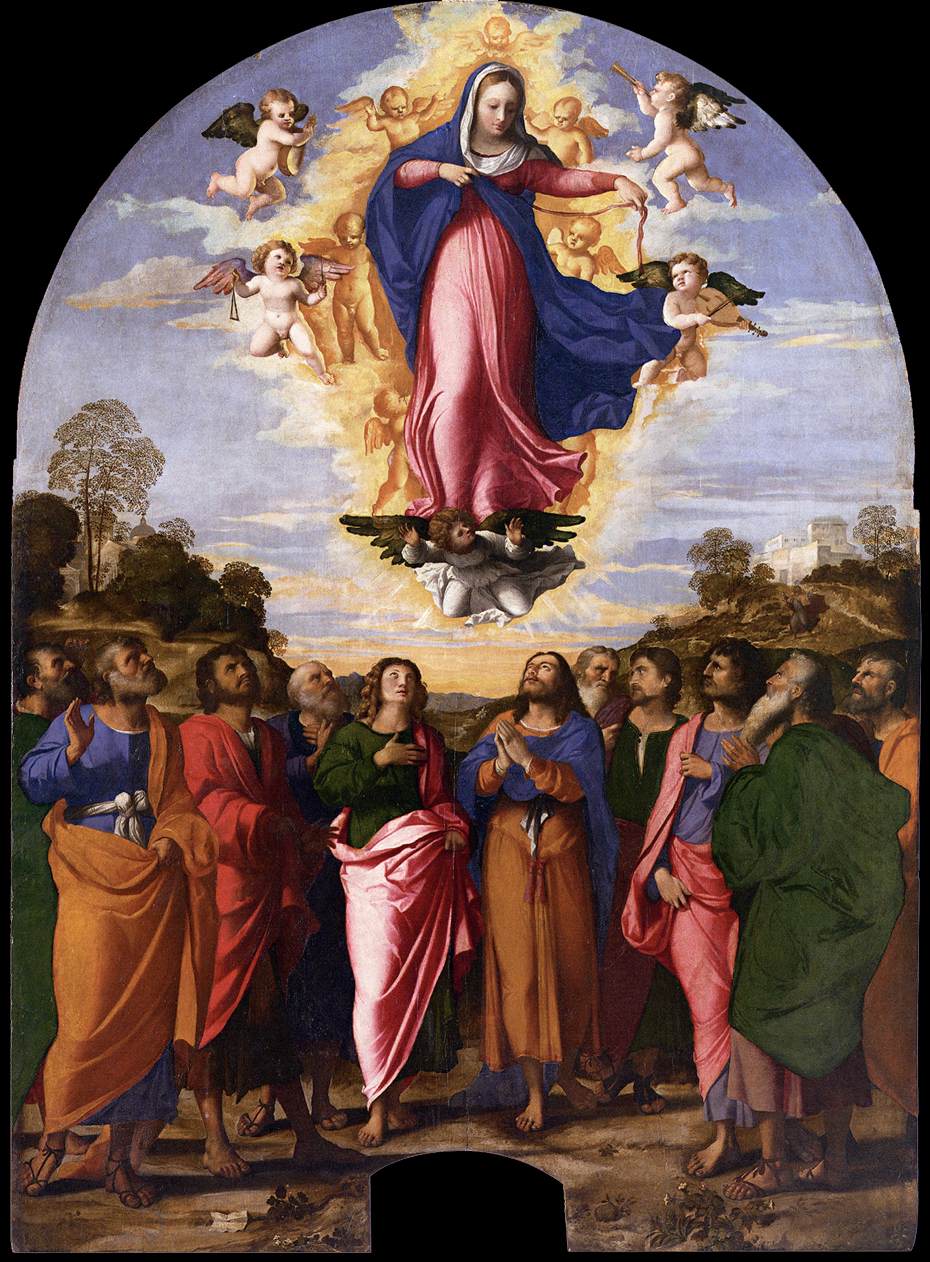
Palma Vecchio
1480 – 1528
Palma Vecchio (Jacopo Palma) (c.1480-1528). Italian painter. born near Bergamo, but active for all his known career in Venice, where he is first documented in 1510. His original name was Jacopo d'Antonio Negretti, but he was using the name Palma by 1513. He is called Palma Vecchio (Old Palma) to distinguish him from Palma Giovane (Young Palma), his great-nephew. Nothing is known of his training, and there is indeed very little secure knowledge about his life and works, none of his pictures being dated or reliably signed and very few of them being certainly identifiable from early sources. His style is distinctive, however, and in practice the definition of his oeuvre is much less problematic than with many of his contemporaries. He painted a few altarpieces for Venetian churches, but most of his work was done for private clients, his speciality being half-length portrayals of beautiful and voluptuous blonde-haired women, sometimes in religious or mythological guise. In opulence of colour and beauty of handling they show the influence of the early work of Titian, and the finest, such as the celebrated La Bella (Thyssen Collection, Madrid), are worthy of his name. Palma also painted some Giorgionesque reclining nudes and some male portraits. Sacre conversazioni (Holy Conversations) is a subject he painted many times; in it, groupings of figures converse in a quiet landscape suffused in a golden glow. Three Sisters (before 1525, Gemaldegalerie, Dresden), also called Three Graces, is one of his best-known works. His work was influential on painters of the next generation in Venice, notably Bonifazio Veronese.
View all works →