Pietro Perugino
1450 – 1523
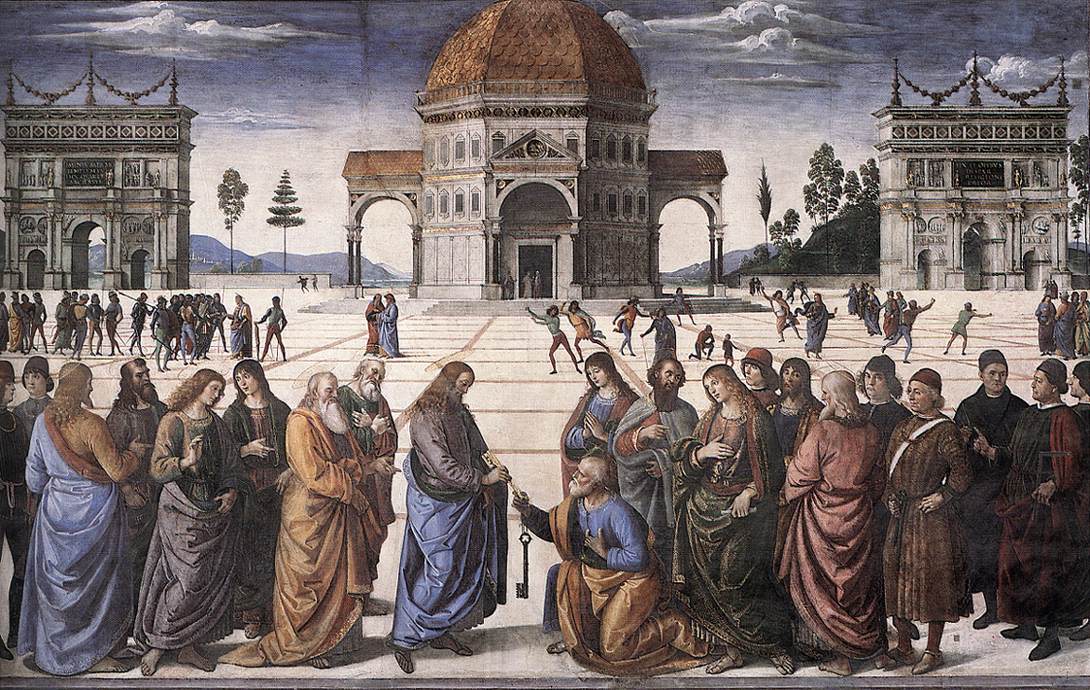
Italian painter, the greatest painter of the Umbrian school (his real name: Pietro di Cristoforo Vannucci), active mainly in Perugia. He studied under Fiorenzo di Lorenzo, assisted Piero della Francesca at Arezzo, and in the early 1470s was a fellow pupil of Leonardo da Vinci and Lorenzo di Credi in Verrocchio 's studio in Florence. In 1479 Perugino was summoned to Rome by Pope Sixtus IV to help decorate the Sistine Chapel. He is recorded in the 1481 contract for the frescoes in the Sistine Chapel (along with Sandro Botticelli, Domenico Ghirlandaio and Cosimo Rosselli ), where his Christ Handing the Keys to St Peter demonstrates his qualities of simplicity, order and clearly articulated composition. He seems to have been the leader of the team. Some of his work in the Sistine Chapel was destroyed to make room for Michelangelo's Last Judgment. The influence of his friend Luca Signorelli strengthened his draughtsmanship, that of Flemings like Hans Memling suggested the landscape background for his portraits as well as their general composition, and to the persistence of Piero's influence is due the use of architectural and landscape settings for his figure compositions. The Pietà (Florence, Accademia) set centrally in a receding arcade, and above all the Cruxifixion with Saints (Florence, Santa Maria Maddalena dei Pazzi), a fresco of 1496 with an extensive landscape linking the three apparent divisions of the wall, are perfect examples of his quiet, pietistic art, with gentle, rather sentimental figures with drooping postures, tip-tilted heads, and mild rounded faces - a type he repeated all his life with, in his later years, dull and routine repetitiveness. From c. 1500 to c. 1504 Raphael was a pupil in his shop and may have helped with the fresco cycle in the Sala del Cambio at Perugia, Perugino's largest (but not best) work in fresco. Raphael's own early work in San Severo at Perugia was later - after his death in 1520 - completed by his master. In 1506 Perugino retired to Perugia, since his style was now hopelessly outmoded in Florence, where, however, it had served to counter-balance the confusion of late Quattrocento style. It was to be the herald of the High Renaissance.
View all works →