Piero Di Cosimo
1462 – 1521
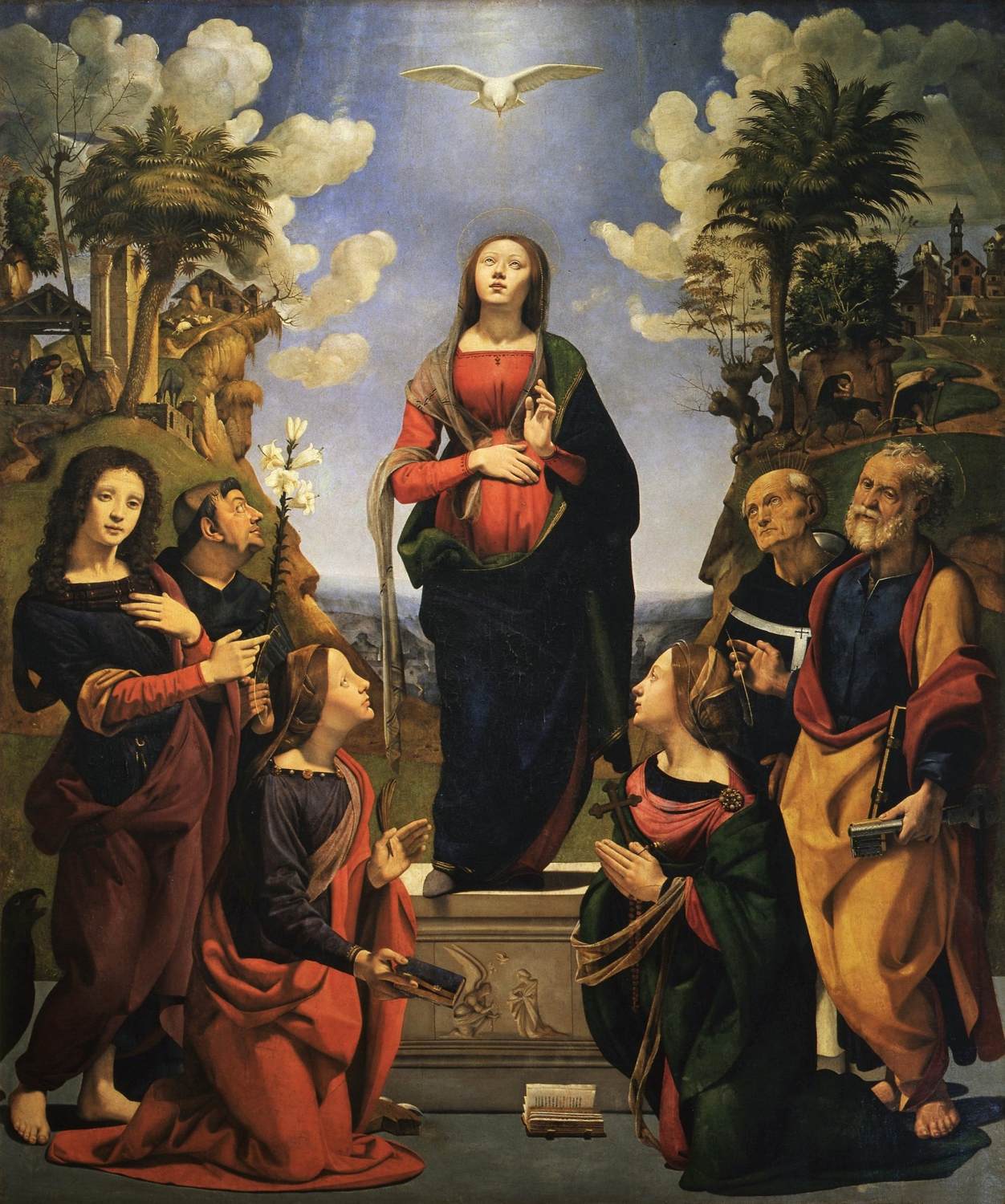
Florentine painter, a pupil of Cosimo Rosselli, whose Christian name he adopted as a patronym. There are no signed, documented, or dated works by him, and reconstruction of his oeuvre depends on the account given in Vasari 's Lives. It is one of Vasari's most entertaining biographies, for he portrays Piero as a highly eccentric character who lived on hard-boiled eggs, "which he cooked while he was boiling his glue, to save the firing". Piero helped Cosimo Rosselli in decorating the Sistine Chapel. Following this debut, his career progressed slowly, bur his style changed. He was influenced by Leonardo and by Luca Signorelli and Filippino Lippi. He excelled at painting animals with a sympathy rare in his age. The paintings for which he is best known are appropriately idiosyncratic - fanciful mythological inventions, inhabited by fauns, centaurs, and primitive men. There is sometimes a spirit of low comedy about these delightful works, but in the so-called Death of Procris (National Gallery, London) he created a poignant scene of the utmost pathos and tenderness. He was a marvellous painter of animals and the dog in this picture, depicted with a mournful dignity, is one of his most memorable creations. Piero also painted portraits, the finest of which is that of Simonetta Vespucci (Musée Condé, Chantilly), in which she is depicted as Cleopatra with the asp around her neck. His religious works are somewhat more conventional, although still distinctive. One of his outstanding religious works is the Immaculate Conception (Uffizi, Florence), which seems to have been the compositional model for the Madonna of the Harpies by his pupil Andrea del Sarto.
View all works →