Pisanello
1395 – 1455
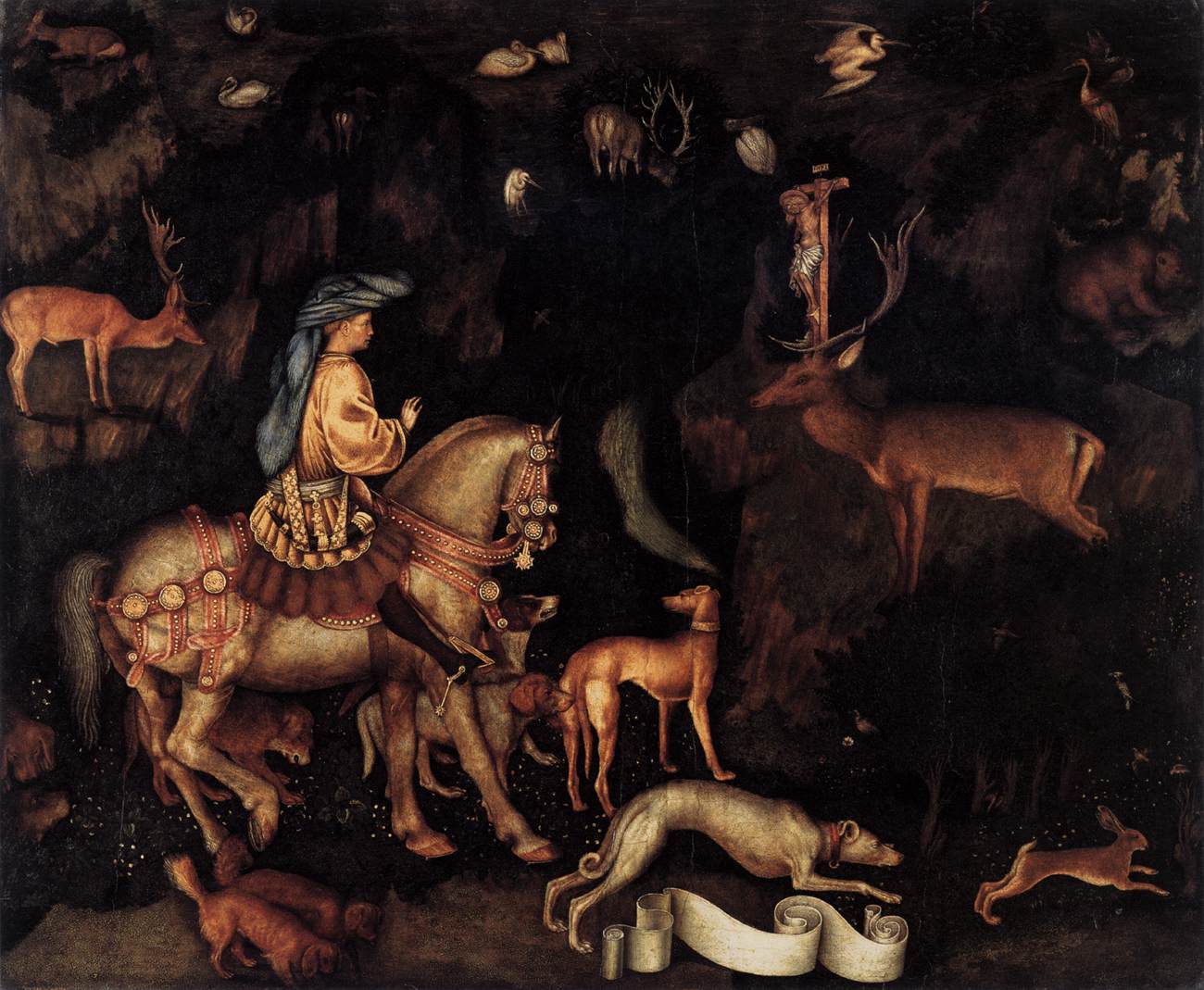
Italian painter, draftsman, and medallist (originally Antonio Pisano), who was the last and most brilliant artist of the ornate, courtly International Gothic style. He presumably came from Pisa (hence his nickname, he was originally named Antonio Pisano), but he spent his early years in Verona, a city with which he kept up his association for most of his life. He studied under Gentile da Fabriano, whose graceful, detailed style he inherited. His successful career also took him to the Vatican and numerous courts of northern Italy. With Gentile da Fabriano, Pisanello is regarded as the foremost exponent of the International Gothic style in Italian painting, but most of his major works have perished, including frescoes in Venice (in which he collaborated with Gentile) and in Rome (in which he completed work left unfinished by Gentile at his death). His surviving documented frescoes are The Annunciation (S. Fermo, Verona, 1423-4) and St George and the Princess of Trebizond (Sta Anastasia, Verona, 1437-38), and attributed to him are some fragments of murals of jousting knights in the Palazzo Ducale in Mantua, uncovered in 1968 and one of the most spectacular art discoveries of the period. A very small number of panel paintings is also given to him, two being in the National Gallery, London. On the other hand, a good many of his drawings survive, those of animals being particularly memorable. They show his keen eye for detail and his ability to convey an animal's personality. In drawings of female nudes he achieves a strength of three-dimensional modeling that establishes an important link between the Gothic and Renaissance styles. Pisanello was also the greatest portrait medallist of his period and arguably of the whole Renaissance, his work setting standards of delicacy, precision, and clarity that have not been surpassed.
View all works →