FINDART

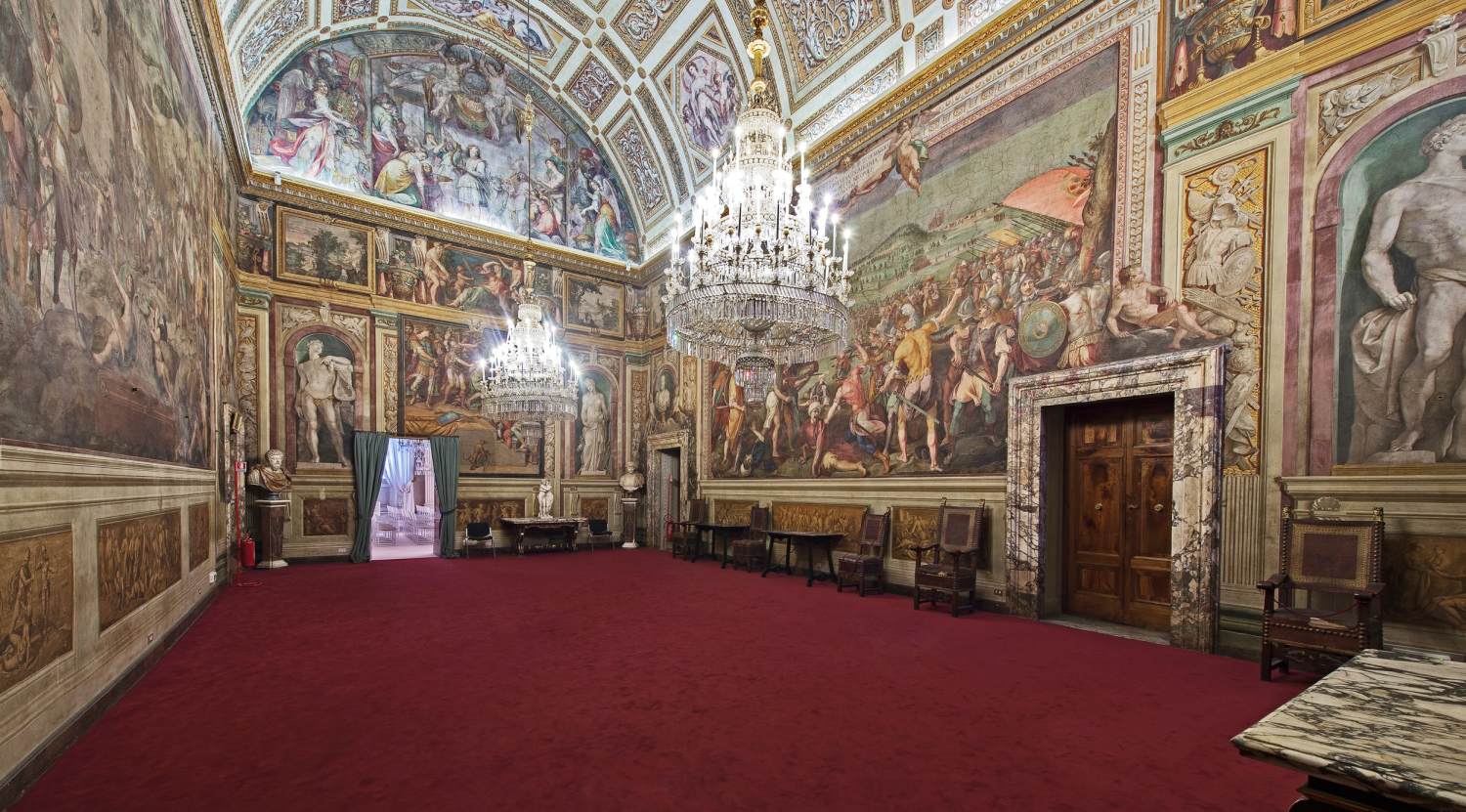
View of the Bona Room

1607 · Palazzo Pitti, Florence

other

This is a view of the Hall of Bona, one of the most sumptuous rooms of the Palatine Gallery and one of the first ones to be frescoed in Pitti Palace at the beginning of the 1600s, when it used to be the main hall of the so-called Apartment of Foreign Princes. Grand Duke Ferdinando I de' Medici commissioned Bernardino Poccetti to decorate this Hall thus carrying out an authentic political and cultural manifesto for his reign, which took as example the spectacular Hall of the 500 in Palazzo Vecchio realized under the commission of his father Cosimo I. The centre of the ceiling hosts the core of the Medici family's celebration: six allegorical female figures represent the virtues of the good prince (Liberality, Glory, Wisdom/Knowledge, Supervision/Command, Mercy and Celebrity/Good Reputation) that are surrounding an oval with Cosimo I with Minerva and Princes' Glory.
Loading map…
View of the Bona Room

About the Artist

Bernardino Poccetti

15481612

Bernardino Poccetti (Bernardo Barbatelli), Italian painter and draughtsman. He was trained in Florence by Michele Tosini, a pupil of Ridolfo Ghirlandaio, and at 22 was admitted to the Compagnia di San Luca and later the Accademia del Disegno. His skill as a fresco painter of façades earned him the sobriquets 'Bernardino delle facciate', '...delle muse' and '...delle grottesche'. Surviving examples include the façade of the Palazzo di Bianca Capello, Florence. His six lunettes of the Life of St Dominic (c. 1582-84; Florence, S Maria Novella, Chiostro Grande) owe much to Andrea del Sarto for the clear compositions and individual figures and to the new emphasis on naturalism of Santi di Tito for the narrative simplicity. Poccetti's progress from small-scale sgraffito decorations to large-scale compositions was aided by drawings supplied by Alessandro Allori. The frescoes celebrating the Capponi family (1583-87; Florence, Palazzo Capponi, Sala Grande) refer to some of the 132 tapestry designs of Joannes Stradanus (e.g. Florence, Palazzo Vecchio) and to his engraved series of the Medicae familiae. Northern sources are also apparent in Poccetti's work. The lunettes of the Martyrdom of the Apostles (c. 1585-90; Florence, San Pier Maggiore, courtyard) show the influence of Lucas Cranach the Elder and Hendrik Goltzius. Albrecht Dürer's Small Woodcut Passion inspired the Calvary and Christ Nailed to the Cross (Florence, San Pier Maggiore, vestibule).

View all works →