Pieter Jansz. Quast
1605 – 1647
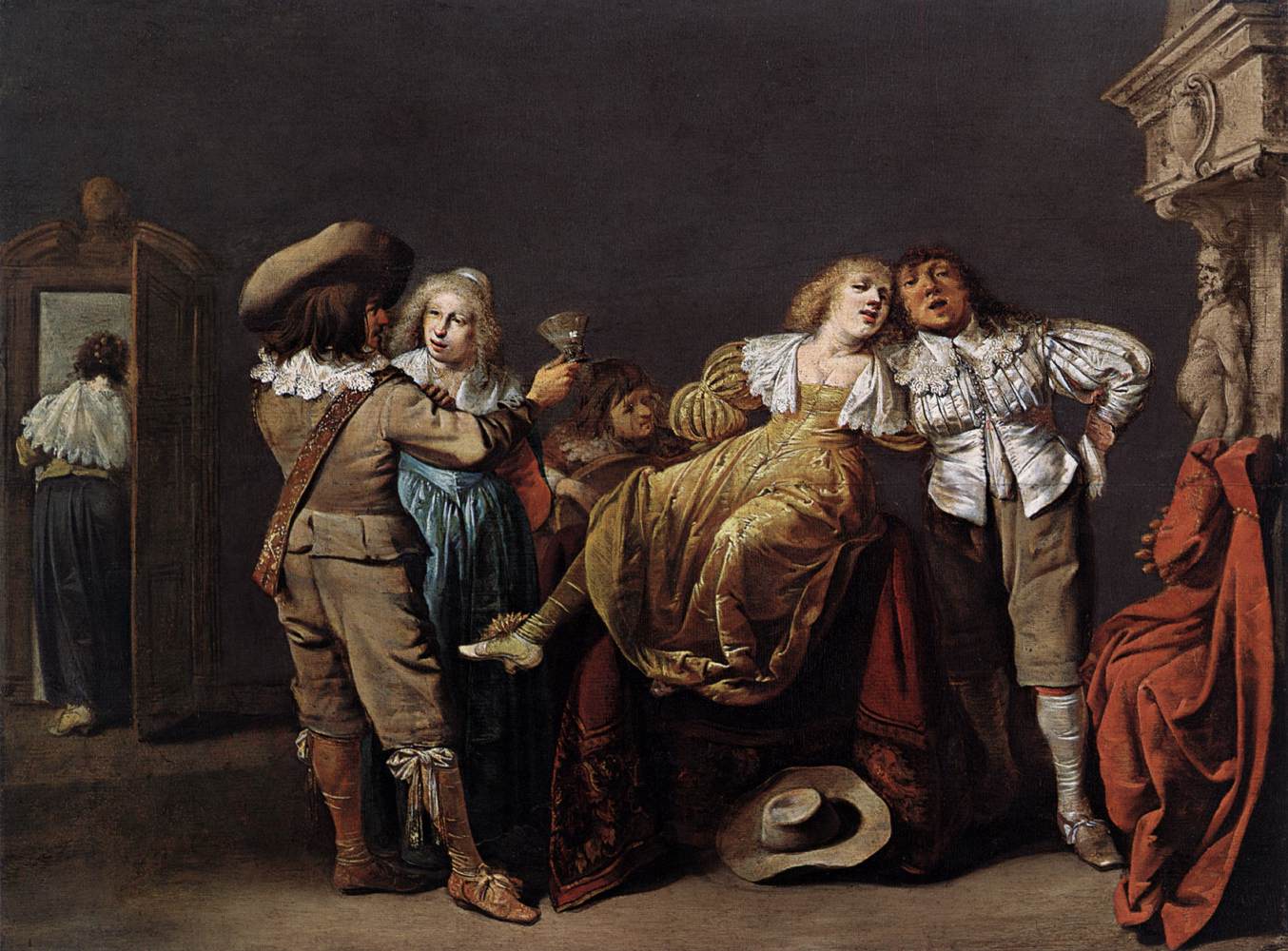
Dutch painter, draughtsman and engraver. He became a master of the Guild of St Luke in The Hague in 1634. His paintings of groups of elegant people, such as the Merry Company (Hamburg, Kunststhalle) and Noble Company (Leipzig, Museum der Bildenden Künste), recall the work of Anthonie Palamedesz, while his scenes with soldiers, for example a Stable Interior (London, National Gallery) and Soldiers at an Inn (1640; Karlsruhe, Staatliche Kunsthalle), recall the work of Pieter Codde. Usually, however, Quast painted operations and tavern scenes with peasants and beggars, whose postures and faces approach caricature, as in the Foot Operation and Card-players with a Woman Smoking a Pipe (both Amsterdam, Rijksmuseum). The scenes, usually on small panels, are heavily and powerfully rendered in warm shades of brown, set off by strong local colouring in the principal figures. His successful peasant scenes are characterized by the use of strong chiaroscuro and a gentle, harmonious palette. The caricatural quality of Quast's peasants recalls the work of his fellow-resident of The Hague, Adriaen van de Venne, but Quast's looser style and many of his individual types are closer to the paintings of Adriaen Brouwer, as well as of Adriaen van Ostade, to whom Quast's best work has sometimes been ascribed. Some of Quast's paintings take the form of political satire, for example a small panel of a Male and Female Beggar, which symbolizes innocent poverty, and its pendant, a Liquor Merchant and his Wife (both Brunswick, Herzog Anton Ulrich-Museum), which symbolizes self-induced poverty. Sources for such paintings included the Balli de Sfessania (1621) and Gobbi (1622) series of etchings by Jacques Callot. Contemporary theatre also provided inspiration for such paintings as the Triumph of Folly (1643; The Hague, Mauritshuis).
View all works →