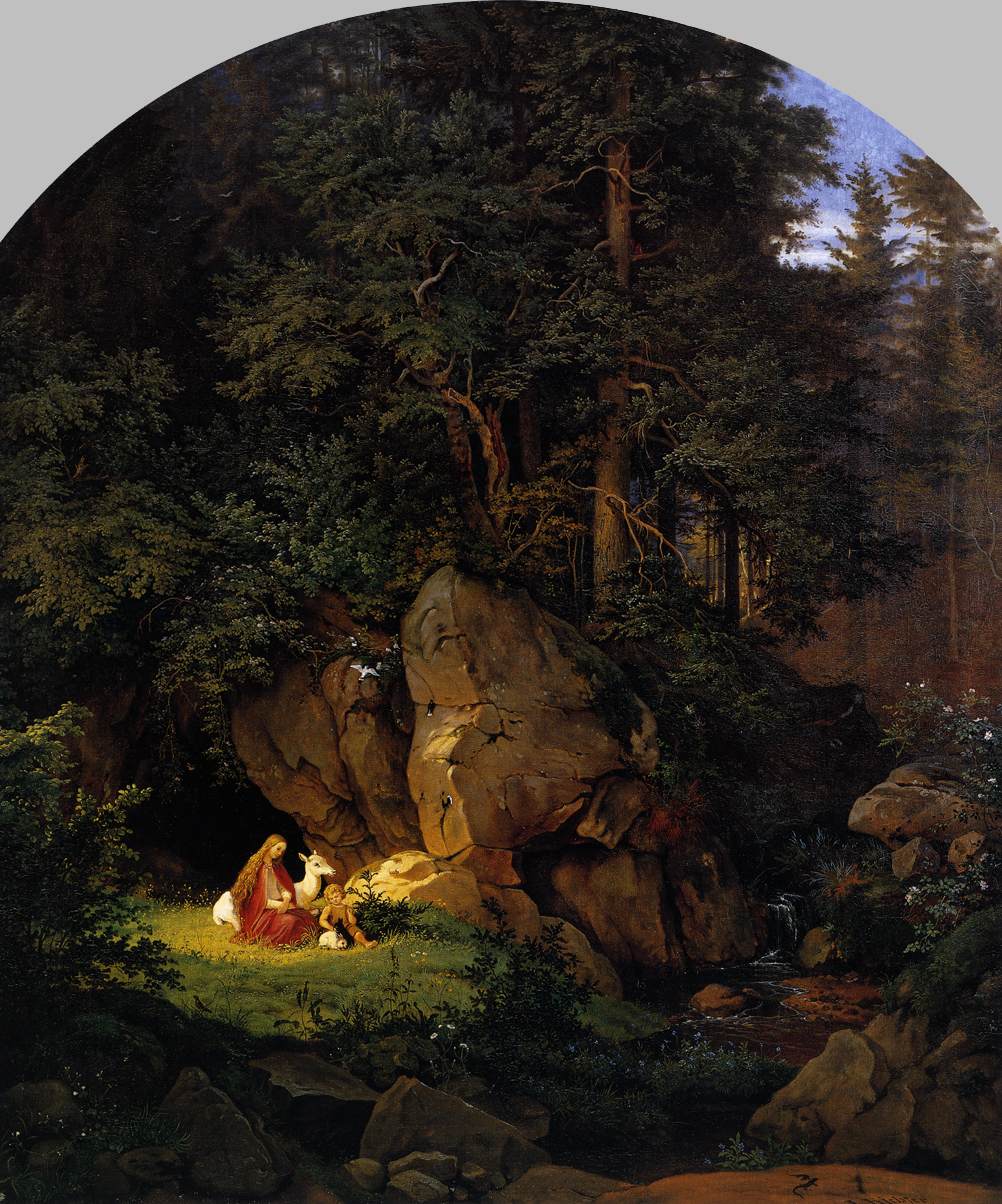
Adrian Ludwig Richter
1803 – 1884
German painter, printmaker and illustrator. He ranks with Moritz von Schwind as the most important representative of late Romantic painting and printmaking in Germany. In contrast to the work of such leading masters of early Romanticism as Philipp Otto Runge and Caspar David Friedrich, which was ambitious in content and innovative in form, Richter's art was more modest in its aims, in line with the restrained intellectual climate of the Biedermeier period. Richter was one of the most beloved artists in Germany during most of the nineteenth century. He was the son and the pupil of Carl August Richter, Professor at the Fine Arts Academy in Dresden. Adrian Ludwig worked under his direction for his first twelve years. In 1820 while traveling as part of his artistic studies he visited Strasbourg and the Midi in France. In 1823, he took another trip, this time to Italy, where he based himself in Rome and traveled to Naples and the surrounding area. From this trip, numerous works were generated including The Valley of the Amalfi. In 1836, he was named Professor of Landscape and Animal Painting at the Dresden Academy. After another trip to Italy, he decided to dedicate himself to works on the German landscape and people. In 1853 he was made an honorary member of the Munich Academy and in 1874 of the Berlin Academy. He was awarded Gold Medals at the Salons in Paris (1855) and Vienna (1883). He also engraved many landscapes and genre scenes, many of which were made into woodcuts and used for illustrations for popular books and children's books.
View all works →