Hubert Robert
1733 – 1808
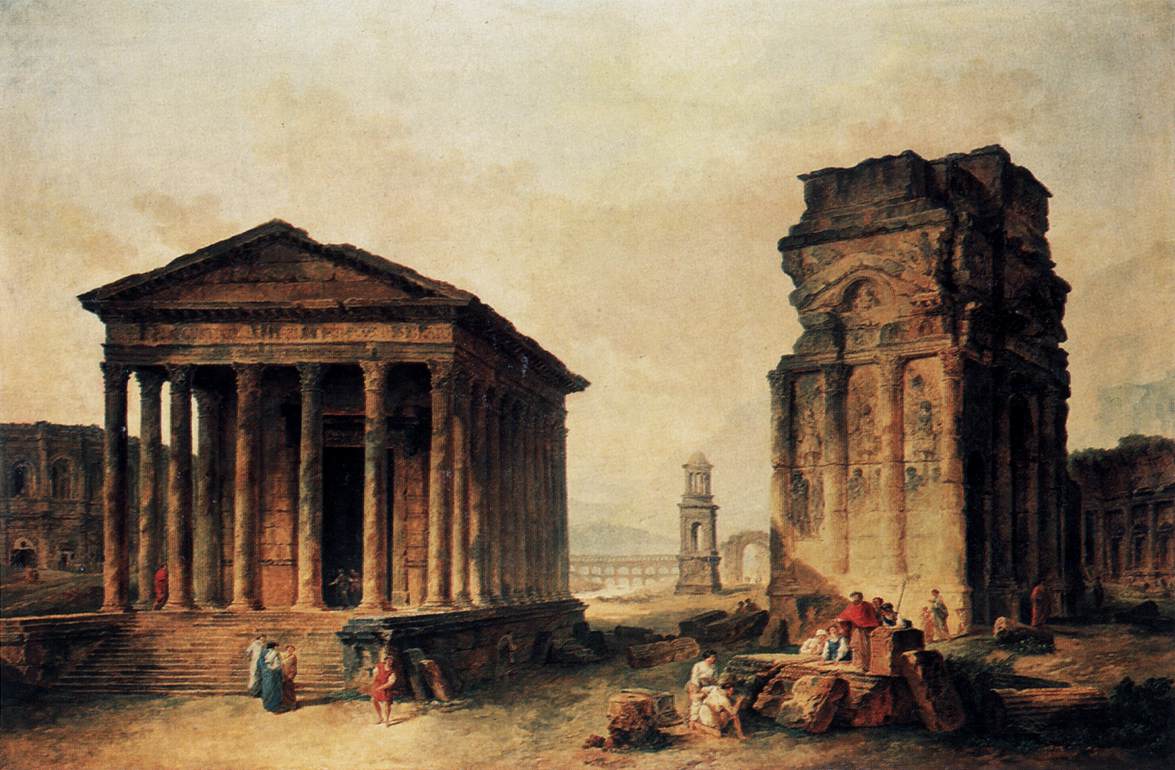
French landscape painter sometimes called "Robert des Ruines" because of his many romantic representations of Roman ruins set in idealized surroundings. Robert went to Rome (1754), was elected to the French Academy there, and became a friend and associate of the renowned etcher of architectural subjects Giambattista Piranesi. In 1759 he joined Abbé de Sainte-Non and the French painter Jean-Honoré Fragonard in travels through southern Italy and Sicily. Each man influenced the other's style but not the other's choice of subjects. At the Villa d'Este, Tivoli, Robert produced a quantity of red chalk drawings of ancient buildings in ruined parks, animated with small figures. Returning to Paris (1765), Robert became a member of the French Royal Academy in 1766. A gifted decorative artist, he based his paintings on his Italian drawings, and his popularity was enhanced by exhibitions at the Salons from 1767 on. In addition to Italian landscapes, he painted scenes of Ermenonville, Marly-le-Roi, and Versailles, near Paris, and of the south of France, with its ruined Roman monuments. He also directed the design of the English garden at Versailles. Under Louis XVI he became Keeper of the King's Pictures and one of the first curators of the Louvre. Although imprisoned during the French Revolution, he continued to work. (He owed his life to an accident whereby another person with the same name was guillotined in his stead.) He collaborated with Fragonard on a commission for the Musée Français in the Louvre during the 1790s, but at the time of his death he was forgotten.
View all works →