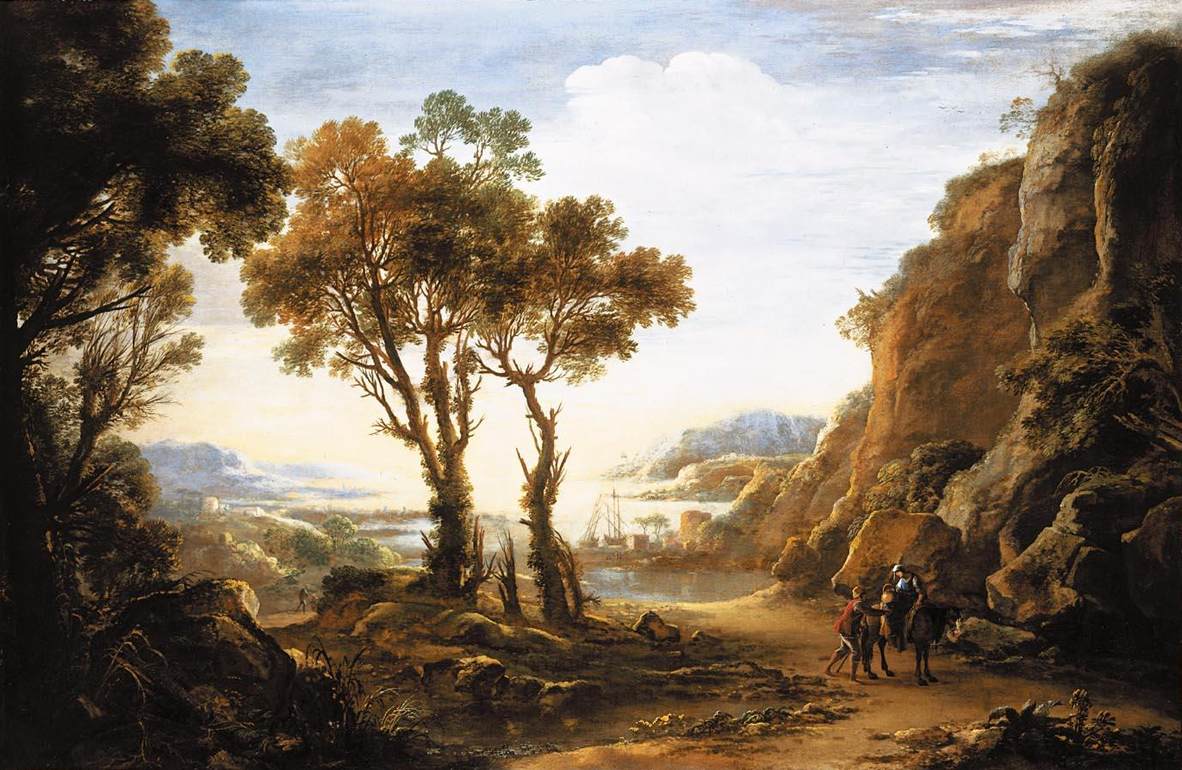
Salvator Rosa
1615 – 1673
Italian Baroque painter and etcher of the Neapolitan school remembered for his wildly romantic or "sublime" landscapes, marine paintings, and battle pictures. He was also an accomplished poet, satirist, actor, and musician. Rosa studied painting in Naples, coming under the influence of the Spanish painter and engraver José de Ribera. Rosa went to Rome in 1635 to study, but he soon contracted malaria. He returned to Naples, where he painted numerous battle and marine pictures and developed his peculiar style of landscape - picturesquely wild scenes of nature with shepherds, seamen, soldiers, or bandits - the whole infused with a romantic poetic quality. His reputation as a painter preceded his return to Rome in 1639. Already famous as an artist, he also became a popular comic actor. During the Carnival of 1639 he rashly satirized the famous architect and sculptor Gian Lorenzo Bernini, thereby making a powerful enemy. For some years thereafter the environment of Florence was more comfortable for him than that of Rome. In Florence he enjoyed the patronage of Cardinal Giovanni Carlo de' Medici. Rosa's own house became the centre of a literary, musical, and artistic circle called the Accademia dei Percossi; here also Rosa's flamboyant personality found expression in acting. In 1649 he returned and finally settled in Rome. Rosa, who had regarded his landscapes more as recreation than as serious art, now turned largely to religious and historical painting. In 1660 he began etching and completed a number of successful prints. His satires were posthumously published in 1710.
View all works →