Rosso Fiorentino
1494 – 1540
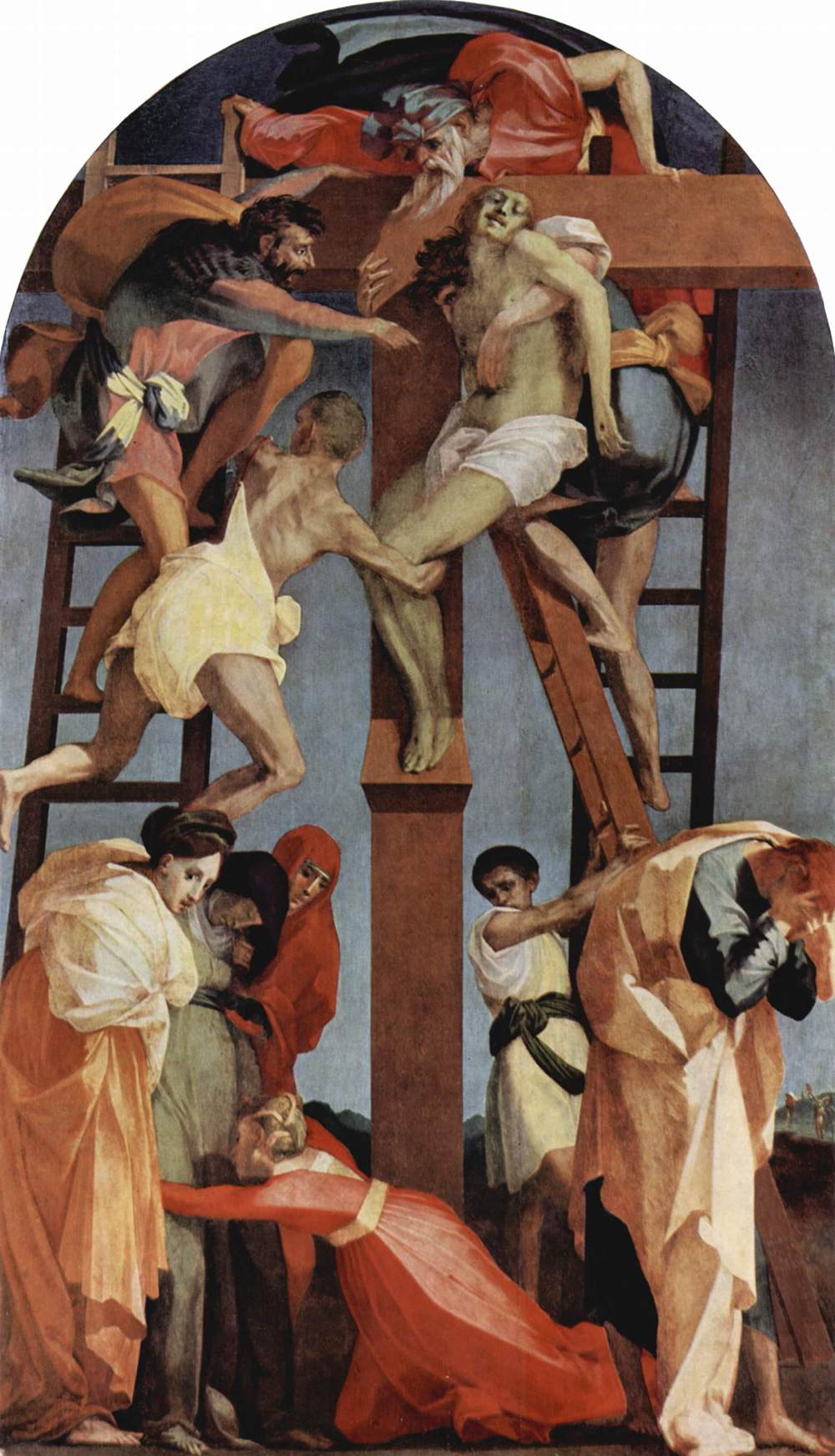
Italian painter and decorator, (also called IL ROSSO, original name Giovanni Battista di Jacopo) an exponent of the expressive style that is often called early, or Florentine, Mannerism, and one of the founders of the Fontainebleau school. Vasari says that he 'would not bind himself to any master' (a story that fits in with his individuality of temperament), but in his youth he learned most from Andrea del Sarto, and together with Andrea's pupil Pontormo (Rosso's friend and close contemporary) he was one of the leading figures in the early development of Mannerism. The earliest works of Rosso and Pontormo combined influences from Michelangelo and from northern Gothic engravings in a novel style, which departed from the tenets of High Renaissance art and was characterized by its highly charged emotionalism. Rosso's work was highly sophisticated and varied in mood, ranging from the Assumption (1517; fresco at SS. Annunziata, Florence) to the refined elegance of the Marriage of the Virgin (S. Lorenzo, Florence, 1523), to the violent energy of Moses and the Daughters of Jethro (Uffizi, Florence, c.1523) and to the disquieting intensity of the Deposítion (Pinacoteca Comunale, Volterra, 1521). At the end of 1523 Rosso moved to Rome, where his exposure to Michelangelo's Sistine ceiling, the late art of Raphael, and the work of Parmigianino resulted in a radical realignment of his style. His Dead Christ with Angels (c. 1526) exemplifies this new style with its feeling for rarefied beauty and subdued emotion. Fleeing from the Sack of the city in 1527, he worked briefly in several central Italian towns. In 1530, on the invitation of Francis I, he went to France (by way of Venice) and remained in the royal service there until his death. Vasari, whose biography of Rosso also includes an entertaining story about his pet baboon, says that he killed himself in remorse after falsely accusing a friend of stealing money from him, but this may well be apocryphal. Rosso's principal surviving work is the decoration of the Galerie François I at the palace of Fontainebleau (c. 1534-37), where, in collaboration with Francesco Primaticcio, he developed an ornamental style whose influence was felt throughout northern Europe. His numerous designs for engravings also exercised a wide influence on the decorative arts both in Italy and in northern Europe.
View all works →