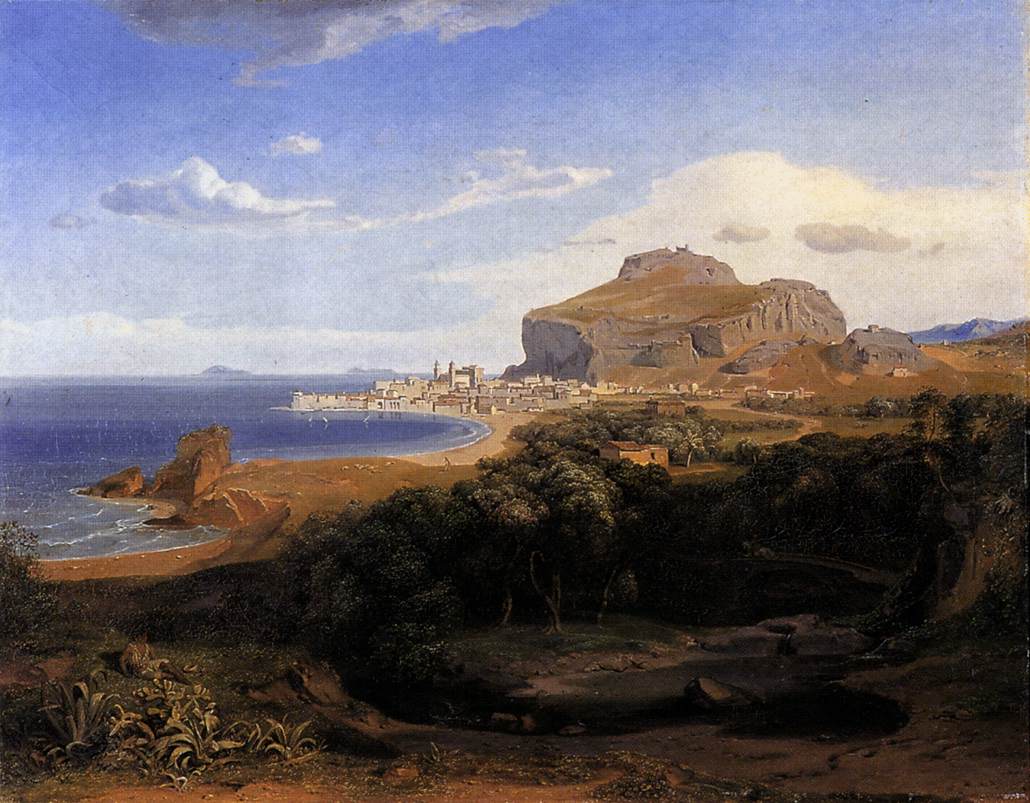
Carl Rottmann
1797 – 1850
German painter. He was taught by his father the university drawing master Friedrich Rottmann (1768-1816); among his fellow students were Carl Philipp Fohr and Ernst Fries. In 1815 Rottmann painted a large watercolour, Heidelberg Castle at Sunset (Heidelberg, Kurpfälzisches Museum). The idealistic forms and romantic lighting are derived from the Scottish painter George Augustus Wallis (1770-1847) who stayed in Heidelberg from 1812 to 1816 on his return from Rome where he had been friendly with Joseph Anton Koch. Rottmann's first picture in oils was derived from two famous paintings in the collection of the Boisserée family, the Pearl of Brabant by Dieric Bouts the Elder or the Younger and the Seven Joys of the Virgin by Hans Memling (now both Munich, Alte Pinakothek). Such a synthesis of two different sets of images was to typify much of Rottmann's later work. At around the same time Rottmann painted his idealized view of Eltz Fortress (destroyed). However, his most beautiful early work in oils is Heidelberg Castle at Sunset with Crescent Moon (c. 1820; Heidelberg, Kurpfälzisches Museum). This work already contains many individual motifs that are important in interpreting the content of Rottmann's later work. King Ludwig I of Bavaria gave Rottmann several major commissions. Two series are important: the one known as the Italian cycle, painted in 1833-38 from journeys undertaken in 1826-27, and the Greece cycle, which was intended for the arcades in the Hofgarten in Munich and was to be entirely in the antique style. Originally there were to be 38 paintings, but finally 23 were executed, all in the encaustic technique.
View all works →