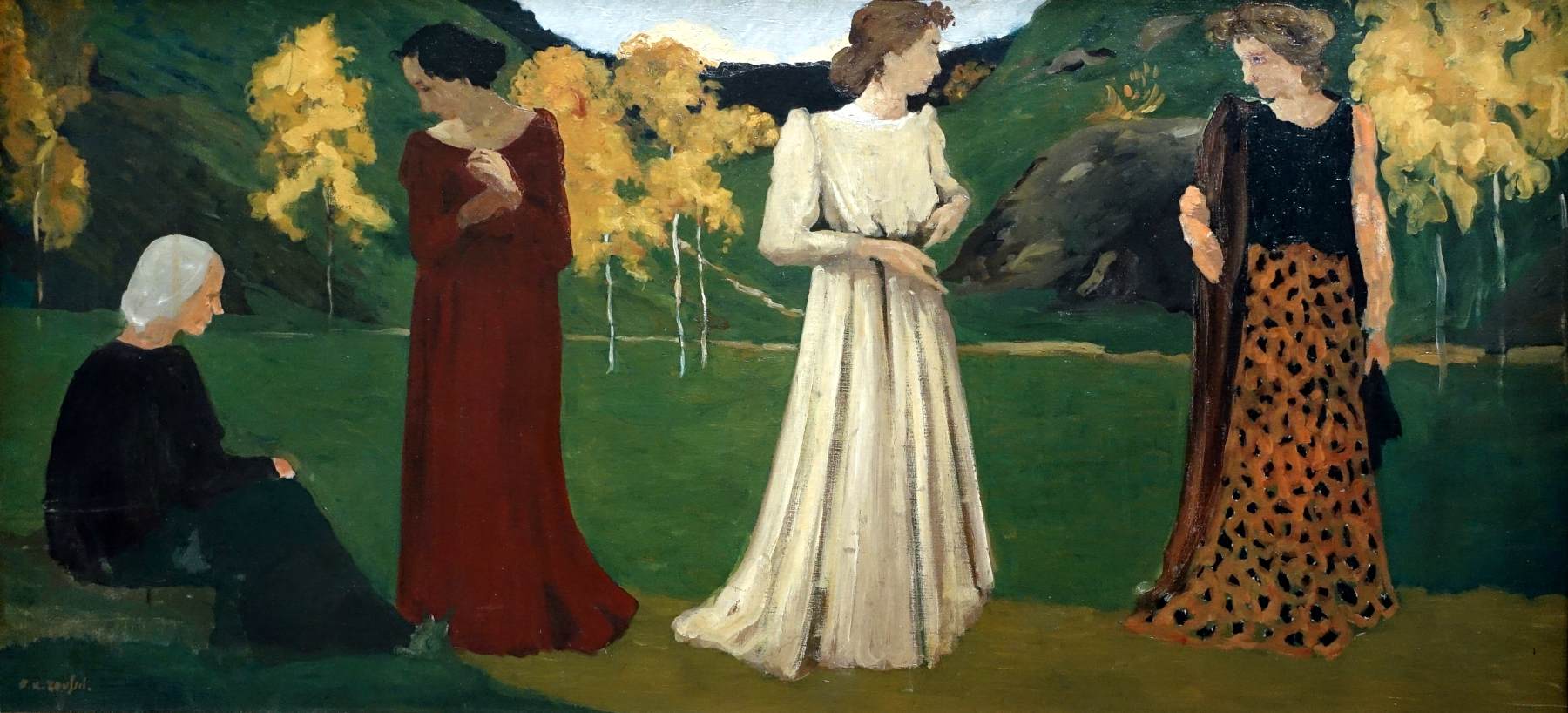
Ker-Xavier Roussel
1867 – 1944
French painter, printmaker and decorative artist. While still at the Lyce Condorcet in Paris, he met Edouard Vuillard (whose sister Marie he married in 1893), Maurice Denis and Paul Srusier. Once they had finished their studies, they all went together to the Acadmie Julian, where Pierre Bonnard, Georges Lacombe (1868-1916), Paul Ranson and Flix Vallotton were already enrolled. Dissatisfied with the teaching of William-Adolphe Bouguereau and Jules Lefbvre, they left the Acadmie in 1890, two years after they had begun to meet together as the Nabis. Roussel took part in exhibitions at the Caf Volpini in 1889 and the Le Barc de Boutteville gallery in 1891. At that time, his pictures applied the rules of Synthetism outlined by Srusier - flat planes of repeated colour encircled by dark lines forming a harmonious rhythm. Like the other Nabis, Roussel did not restrict himself to easel painting but also produced murals, stained glass and lithographs: the colour lithograph the Training the Dog, which he contributed to the anthology Amours (Paris, 1892-98) published by the dealer Ambroise Vollard, was the first of several such projects in which he developed the Symbolist character of his work. The 12 lithographs he contributed to another Vollard publication, Album de Paysages (Paris, 1899), vividly expressed the pantheist vision of nature that was to characterize his later work. Because of illness, Roussel was forced to leave Paris and to spend more time in his property at L'Etang-la-Ville. There he was visited by friends, particularly Srusier. His participation in the first Salon des Indpendants in 1901 was still marked by Synthetist precepts, but his pictorial break with the avant-garde had probably already been made. Abandoning flat planes of colour within an enclosing line, he reverted to a Neo-Impressionist technique characterized by broad, clearly visible brushstrokes, which were more suggestive than descriptive, and by an emphasis on tonal relationships within an overall impression of colour. He applied such methods to rustic landscapes often inhabited by mythological figures. Roussel retained his interest in the decorative arts, in 1913 painting the backdrop for the Thtre des Champs-Elyses in Paris and the huge mural painting Pax Nutrix for the Palais des Nations in Geneva, followed by The Dance for the Palais de Chaillot in Paris on the occasion of the Exposition Universelle in 1937.
View all works →