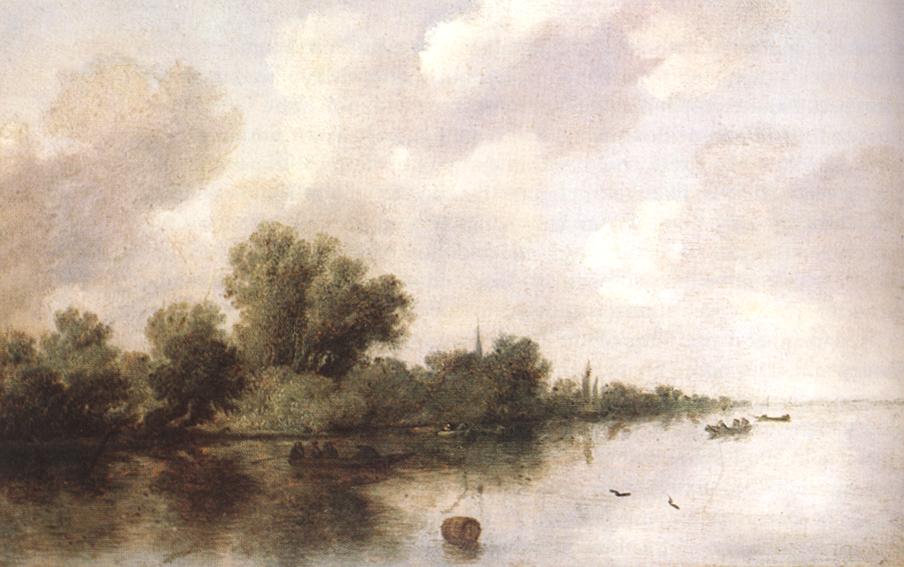
Salomon van Ruysdael
1602 – 1670
Dutch landscape painter of the Baroque style, uncle of the landscape artist Jacob van Ruisdael. Originally named de Goyer, as was his brother Isaack (also a painter and the father of Jacob van Ruisdael), Salomon entered the Haarlem Guild of St Luke in 1628. His first dated pictures are from 1627. He spent his whole life in Haarlem, where he was head of the guild in 1648. Van Ruysdael's early works - winter scenes - continue the tradition of Esaias van de Velde, and his early landscapes are based on the colour schemes and compositions of Pieter Molyn; it has been suggested that he may have studied with either or both painters. At least by 1628 he is mentioned as a landscape painter of Haarlem. Unlike certain other landscape painters of the period, his nephew among them, van Ruysdael generally painted actual landscapes of such places as Arnhem, Dordrecht, and Utrecht, sometimes combining motifs from different places in one picture. His early river landscapes of the 1630s, which are characterized by diagonal compositions of the dunes, are similar in composition and use of colour to the celebrated river scenes of his contemporary Jan van Goyen. Experts agree that van Ruysdael's most powerful work was done after 1645. His command of the landscape elements - great trees anchoring one side of the composition, distant views that draw the eye, and a vast expanse of sky and clouds - seems more assured, and his use of colour for effect more brilliant. From that point van Ruysdael became increasingly interested in light effects and decorative elements in his compositions. Critics have speculated that his change of style was in part owing to the influence of several Dutch painters (such as Jan Both) who were returning to Holland from study in Italy. Many of van Ruysdael's later works are monumental in format and design, and they exhibit a masterly rendering of atmospheric effects. Though his landscapes are most characteristic of his work, between 1659 and 1662 van Ruysdael also painted a number of excellent still-lifes of game. His son Jacob Salomonszoon (1635-81) was also a landscape artist.
View all works →