Théo van Rysselberghe
1862 – 1926
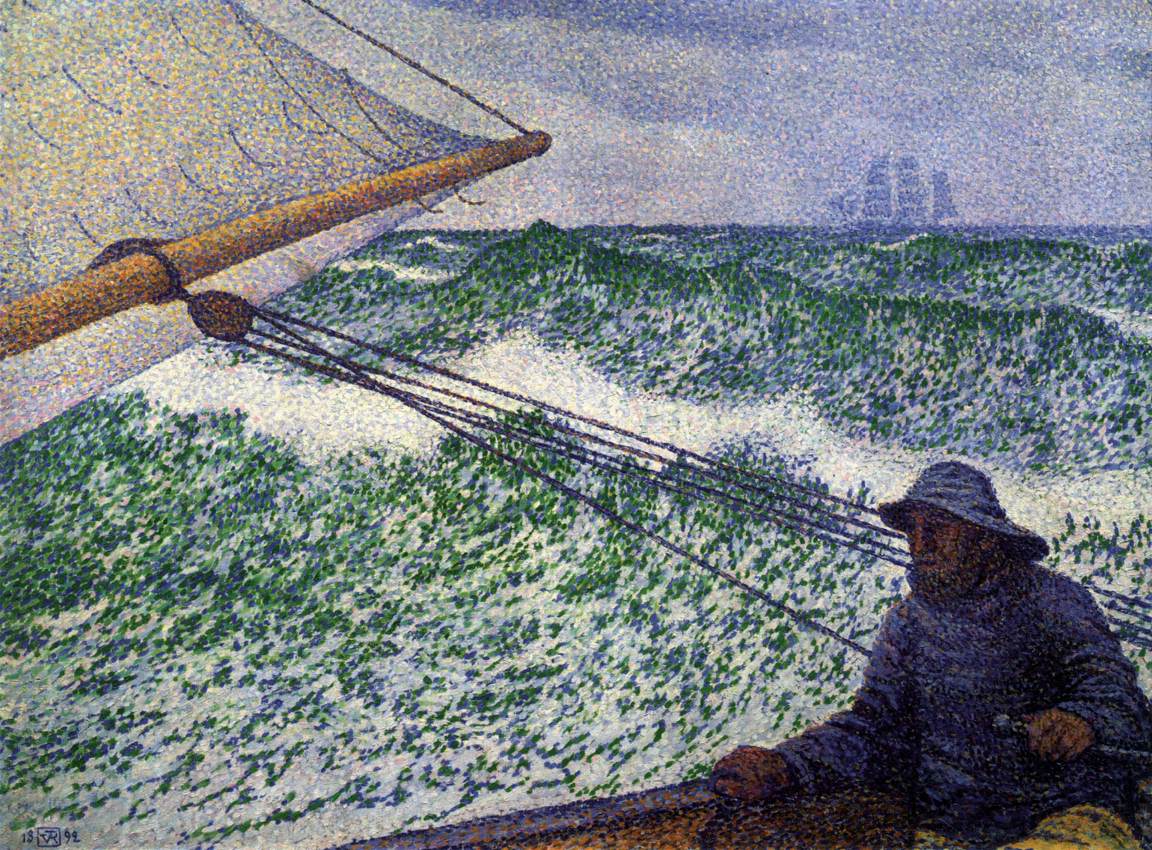
Belgian painter, designer and sculptor, brother of the architect Octave Van Rysselberghe (1855-1929). He was enrolled in the Academie van Beeldende Kunsten in Ghent at an early age. In 1879 he became a pupil of Jean-François Portaels, director of the Académie Royale des Beaux-Arts in Brussels, whose Orientalist works he admired. Van Rysselberghe first exhibited at the Salon in Brussels in 1881. The next year he won a travelling scholarship and, following in the footsteps of Portaels, visited Spain and Morocco. With fellow artists Darío de Regoyos and Constantin Meunier, Van Rysselberghe recorded picturesque scenes of everyday life. He exhibited these Mediterranean pictures in 1883 at L'Essor. He attended the historic meeting on 28 October 1883 at which the avant-garde exhibition society Les XX was created, and at their exhibition in 1885 he showed the results of a second Moroccan trip, including the exotic Fantasia (Brussels, Musée Royal d'Art Moderne). In 1886 the painter travelled with the poet Emile Verhaeren to Paris, where he met Georges Seurat whose painting he admired, particularly A Sunday Afternoon at the Island of Grande Jatte. Following his contact with Neo-Impressionists like Seurat, Signac , Cross and Pissarro in Paris, van Rysselberghe turned to Pointillism himself, becoming the main exponent of the style in Belgium and one of Belgium's most important artists of the fin-de-siecle period. In the late 1880s and early 1890s, the painter travelled in Spain, North Africa, the Middle East and Europe. In 1898, he moved from Brussels to Paris where he joined the literary Symbolist group. After the death of Georges Seurat, van Rysselberghe gradually abandoned the Pointillist technique and turned to a more Realist style. He was famous for his portraits of poets and other literary figures and created an oeuvre of etchings and lithographs. He also designed some beautiful various posters for bookshops and art galleries. Van Rysselberghe and his wife, who was fondly known as Madame Théo, are said to have played an important role in the life of André Gide. Between 1905-1910, he settled in Saint Clair in Provence, where he primarily executed portraits of his wife as well as of his daughter Elisabeth.
View all works →