Floris Gerritsz. van Schooten
1590 – 1655
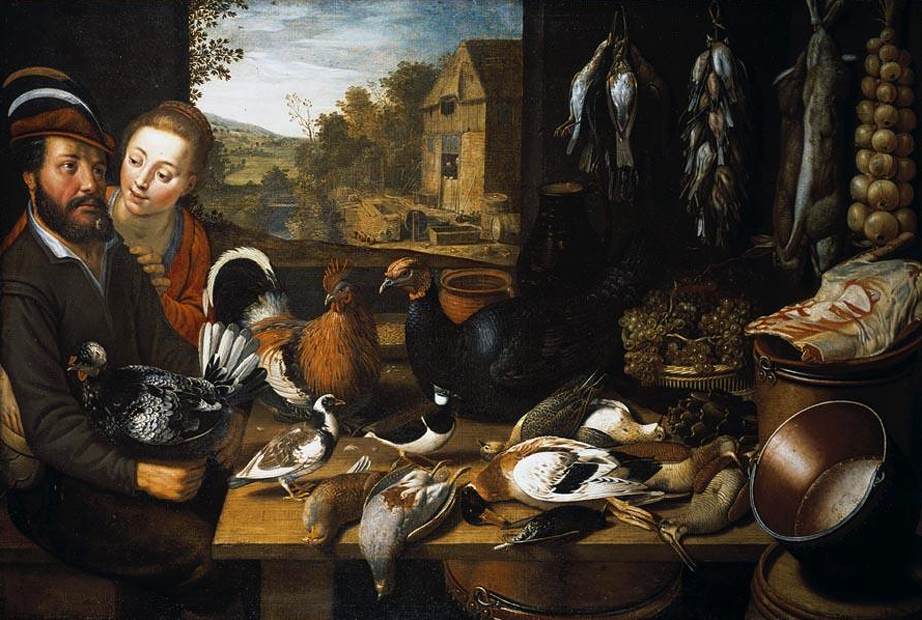
Dutch painter. His considerable output of still-life paintings covers a variety of styles and formats reflecting different influences. His large market or kitchen scenes, with or without figures, showing an abundance of produce (e.g. 1634; Brunswick, Herzog Anton Ulrich-Museum), clearly belong to the tradition of Pieter Aertsen and Joachim Beuckelaer. Van Schooten's breakfast-pieces, with an accumulation of items on a table top, tilted towards the spectator and covered with rugs or white damask cloths, are often inseparable from those of his Haarlem contemporaries Nicholaes Gillis and Floris van Dijck. These horizontal panels, with cheese, hams, bread, all on separate pewter or porcelain plates, with vertical accents from tankards, salt-cellars and wine glasses, gradually evolved towards smaller-scale still-lifes with simplified content (e.g. Haarlem, Frans Halsmuseum ). This signals a transition from his early style towards that of the younger Haarlem masters of the monochrome breakfast-pieces, Pieter Claesz. and Willem Heda. Van Schooten's later work often focuses on fruit, whether a bowl of plums or a basket of grapes, with cherries or berries on small plates arranged in a diagonal across a table top. A pewter beaker with punched decoration frequently appears in these simplified compositions. These works are pleasing, but the mood is mundane, and they lack the dignity and grandeur of Claesz. and Heda and of van Schooten's own earlier breakfast-pieces. The artist's practice of signing his work with a small monogram, often tucked away on a knife blade or dish edge, has contributed to the tendency for his pictures to be attributed to others, something often found with the work of an artist of widely varying formats and uneven quality.
View all works →