Luca Signorelli
1450 – 1523
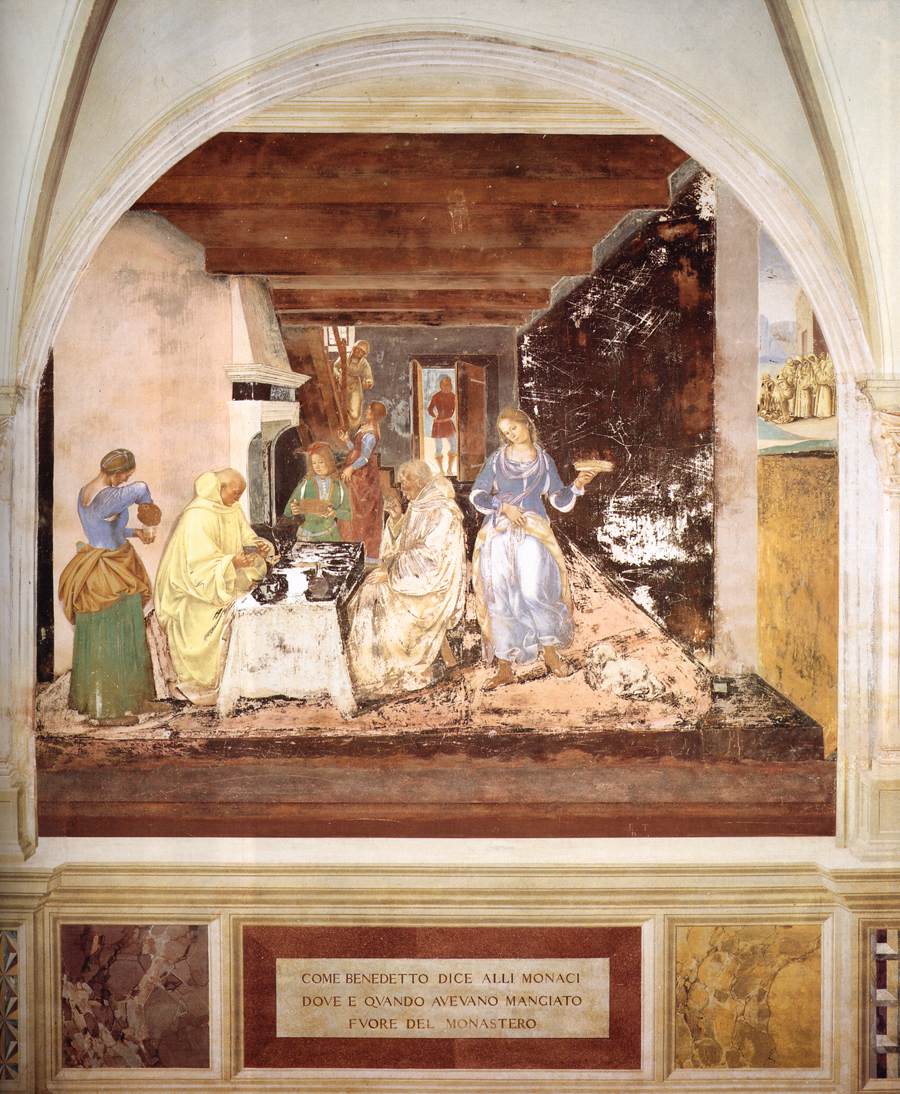
Italian painter from Cortona, active in various cities of central Italy, notably Arezzo, Florence, Orvieto, Perugia, and Rome. According to Vasari, Signorelli was a pupil of Piero della Francesca and this seems highly probable on stylistic grounds, for his solid figures and sensitive handling of light echo the work of the master. Signorelli differed from Piero, however, in his interest in the representation of action, which put him in line with contemporary Florentine artists such as the Pollaiuolo brothers. The Scourging of Christ (c. 1480), a signed processional banner for the church of Santa Maria del Mercato at Fabriano, reveals his developed handling of anatomy. Between 1477 and 1482 he decorated the Sacristy of St John in the Santuario della Santa Casa (Sanctuary of the Holy House) at Loreto. He must have had a considerable reputation by about 1483, when he was called on to complete the cycle of frescoes on the walls of the Sistine Chapel in Rome, left unfinished by Botticelli, Ghirlandaio, Perugino, and Rosselli. (It is not known why these four artists abandoned the work in 1482, but it has been suggested that they simply downed tools because of slow payment.) Signorelli completed the scheme with distinction. Signorelli worked in Rome until 1484 when he returned to his native Cortona, which remained from this time his home. In the Monastery of Monte Oliveto Maggiore (Siena) he painted eight frescoes, forming part of a vast series of the life of St Benedict. From the Monastery of Monte Oliveto Maggiore went to Orvieto, where he painted a magnificent series of six frescoes illustrating the end of the world and the Last Judgement (1499-1504). In the grand and dramatic scenes in Orvieto, inspired by the Divine Comedy of Dante Alighieri, he displayed a mastery of the nude in a wide variety of poses surpassed at that time only by Michelangelo. Vasari says that "Luca's works were highly praised by Michelangelo" and several instances of close similarity between the work of the two men can be cited; perhaps the most interesting is the enigmatic seated nude youth in Signorelli's Last Acts and Death of Moses in the Sistine Chapel, which is remarkably close to some of the Ignudi painted by Michelangelo on the ceiling of the chapel a quarter of a century later. By the end of his career, however, Luca had become a conservative artist, working in provincial Cortona, where his large workshop produced numerous altarpieces.
View all works →