Hugo Simberg
1873 – 1917
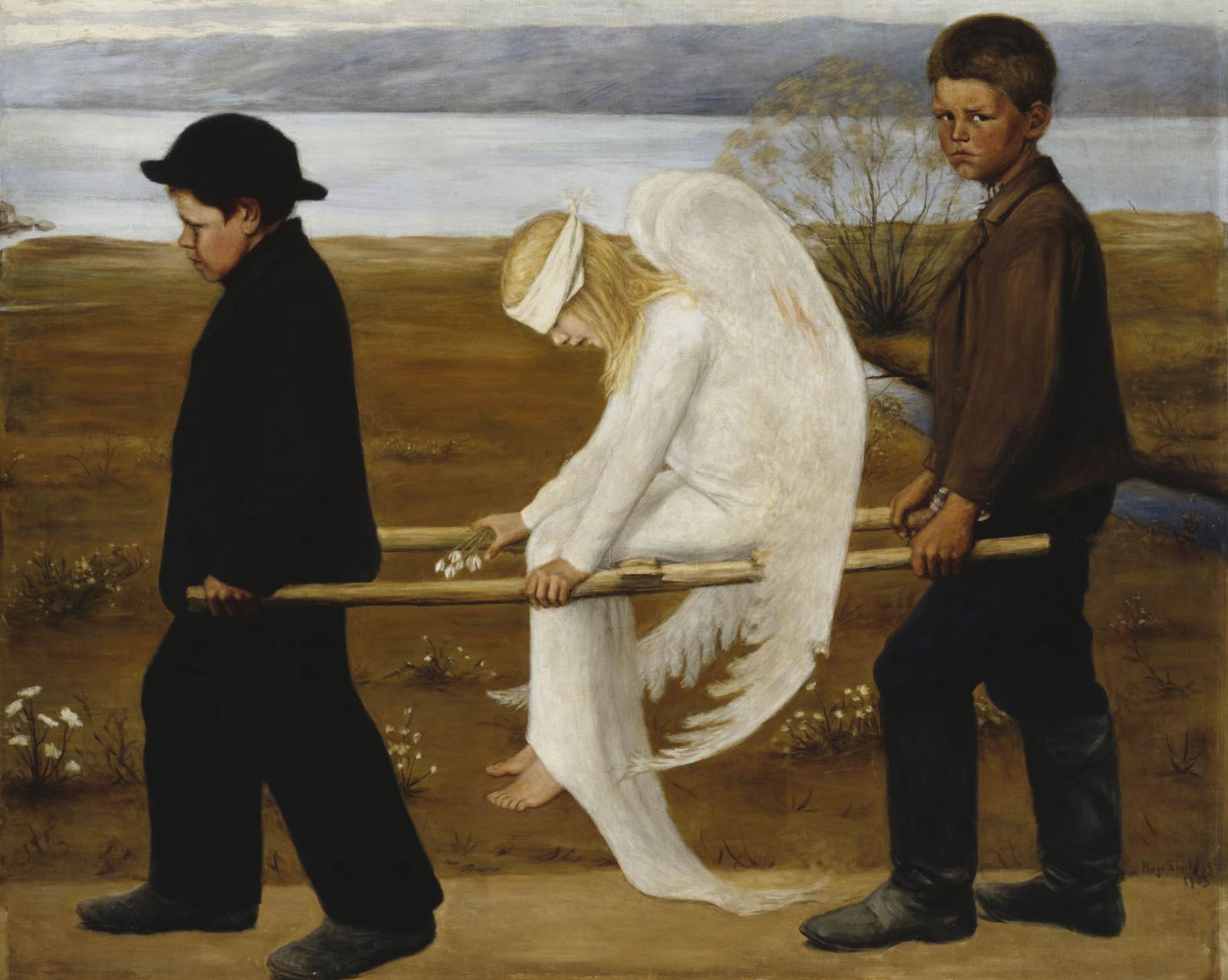
Finnish painter and printmaker. He first studied at the Finnish Fine Arts Association in Helsinki. His natural inclination towards mysticism led him to seek the instruction of Akseli Gallen-Kallela, with whom he studied in Ruovesi intermittently between 1895 and 1897. Gallen-Kallela quickly discovered his pupil's remarkable talents and focused his training upon the techniques of graphic art. Together they formed the foundation of modern Finish graphic art. Gallen-Kallela's influence, particularly his Symbolist synthesis of the National Romantic style, is evident in Simberg's early works, such as Frost and Autumn (both 1895; Ateneumin Taidemuseo, Helsinki), which are highly personal expressions of the mysticism of nature. These small allegorical watercolours convey in a deliberately primitive style the despondency of autumn, fusing many of Simberg's unique, fairy-like motifs. As a painter, Simberg produced chiefly small-format watercolours and prints. His favourite themes were the Poor Devil and Death. Between 1905 and 1906, Simberg frescoed Tampere Cathedral, designed in the National Romantic style by Lars Sonck (1870-1956) and built between 1902 and 1907. The focus of the decoration is an ornamental frieze running around the front of the gallery. The unconventional subject matter and style of the cathedral paintings caused a scandal when they were unveiled in 1907. The criticism discouraged Simberg and played a part in deepening his sense of artistic crisis. Simberg may be considered one of the inspirational forces behind Finnish painting of the turn of the century.
View all works →