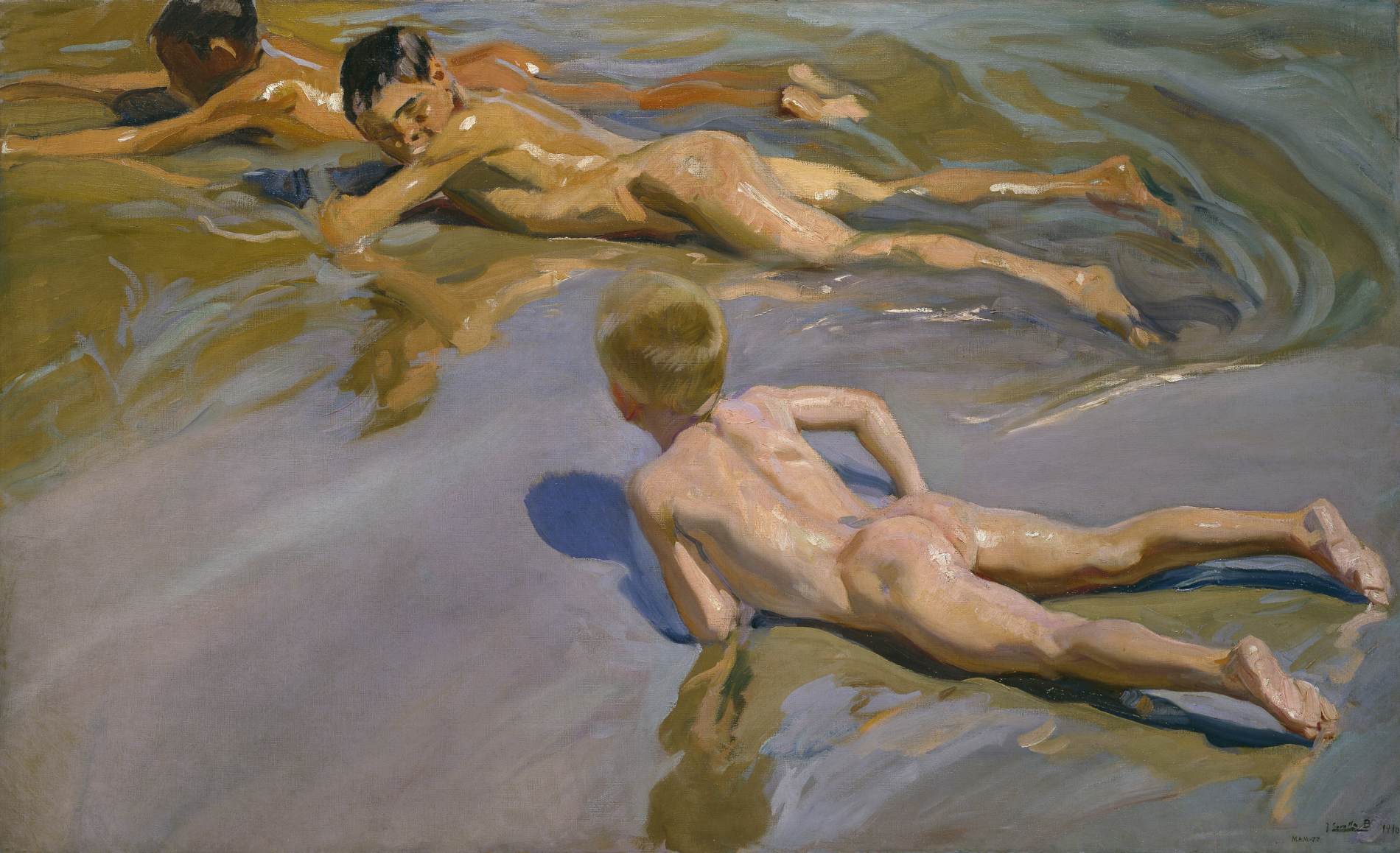
Joaquín Sorolla Y Bastida
1863 – 1923
Spanish painter, noted for his large landscapes in full, glowing sunlight, painted in strong colour and in a bold, fluent style. Sorolla studied at the Trades and Handicrafts School in Valencia and later at the San Carlos Fine Arts Academy of that city. During his student days, he met the photographer Antonio García, who later became his supporter. In 1888, he married García's daughter, Clotilde, who bore him three children between 1889 and 1895. In 1884 he received a scholarship from the Valencian authorities to study in Italy, where he lived from 1885 to 1889. In 1890, Sorolla settled in Madrid. Over the course of the following decade he worked hard to establish a name for himself, participating in numerous national and international exhibitions. In 1900, he won a medal of honour at the Paris World Fair. From 1905 the artist began to plan a series of major individual exhibitions, supported by leading dealers and galleries. The first took place in 1906 in Paris at the Galerie Georges Petit, and Sorolla became famous in Paris and as a consequence throughout Europe. Between 1909 and 1911, he was in the United States, where he showed his works in several cities. These presentations were supported by the Hispanic enthusiast and collector, Archer M. Huntington, who became Sorolla's main champion in America, commissioning him to decorate the Hispanic Society's library in New York with scenes of the different regions of Spain. In order to carry out the commission as accurately as possible, Sorolla travelled tirelessly through Spain, an undertaking that badly undermined his health and he suffered a stroke in 1920, which left him incapable of working. He died three years later.
View all works →