Adriaen van Stalbemt
1580 – 1662
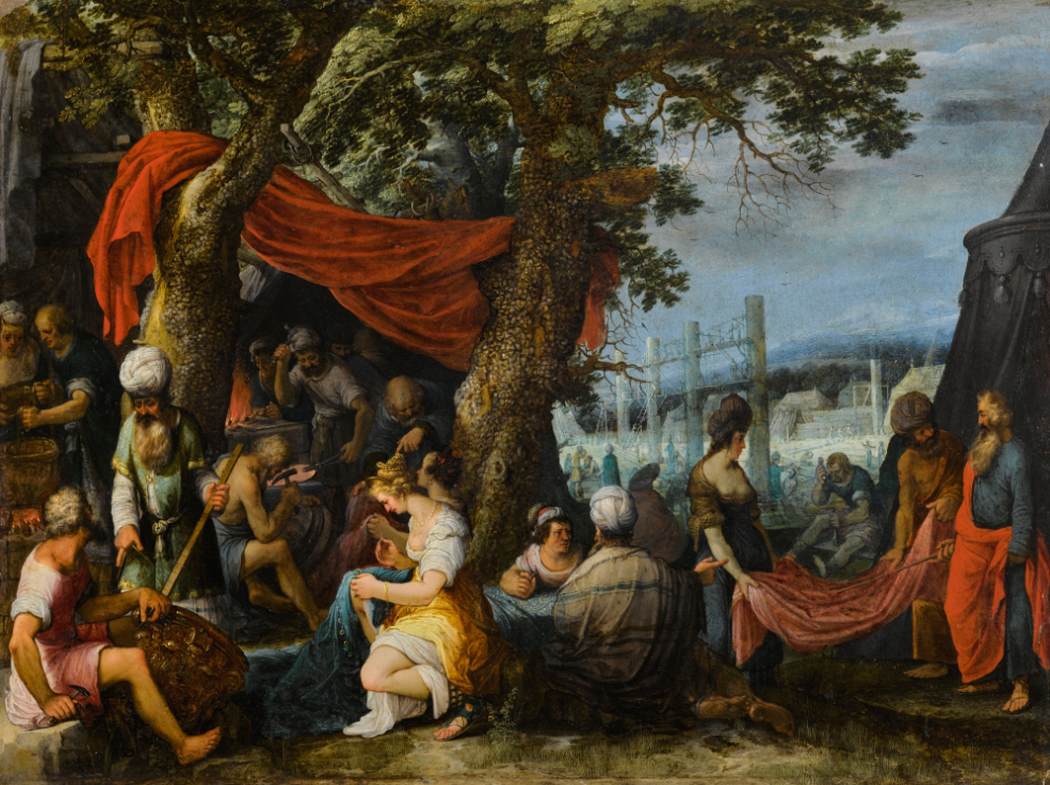
Flemish painter and etcher. After the fall of Antwerp (1585) his Protestant family emigrated to Middelburg, but Adriaen later returned to Antwerp. His first dated work is a Landscape with Hunters (1604; Private collection). In 1609 or 1610 he became a master; he trained three apprentices. In 1633-04 he spent ten months in England, where, among other work, he painted two views of Greenwich (e.g. View of Greenwich with King Charles I, Queen Henrietta Maria and the Court, Royal Collection, Windsor). As well as landscapes, he also painted religious, mythological and allegorical scenes and was an etcher. His oeuvre shows great stylistic variety but, because of the small number of dated works, can only with difficulty be catalogued chronologically. Some works, such as the Landscape with Fables (Koninklijk Museum voor Schone Kunsten, Antwerp), reveal the influence of Jan Breughel the Elder, while some are duller in colour and do not display the same meticulous brush technique. David Slaying Goliath (1618; Madrid, Prado) is a collaborative work with Pieter Brueghel the Younger, in which the figures are undoubtedly the work of van Stalbemt. One group of works previously attributed to Adam Elsheimer has now been reattributed to van Stalbemt. The influence of Elsheimer, particularly noticeable in the composition, was presumably passed on via David Teniers the Elder, who worked for a period in Elsheimer's studio. Van Stalbemt's later work also reveals clear similarities to the art of Hendrick van Balen.
View all works →